
Bioresearch Monitoring (BIMO)
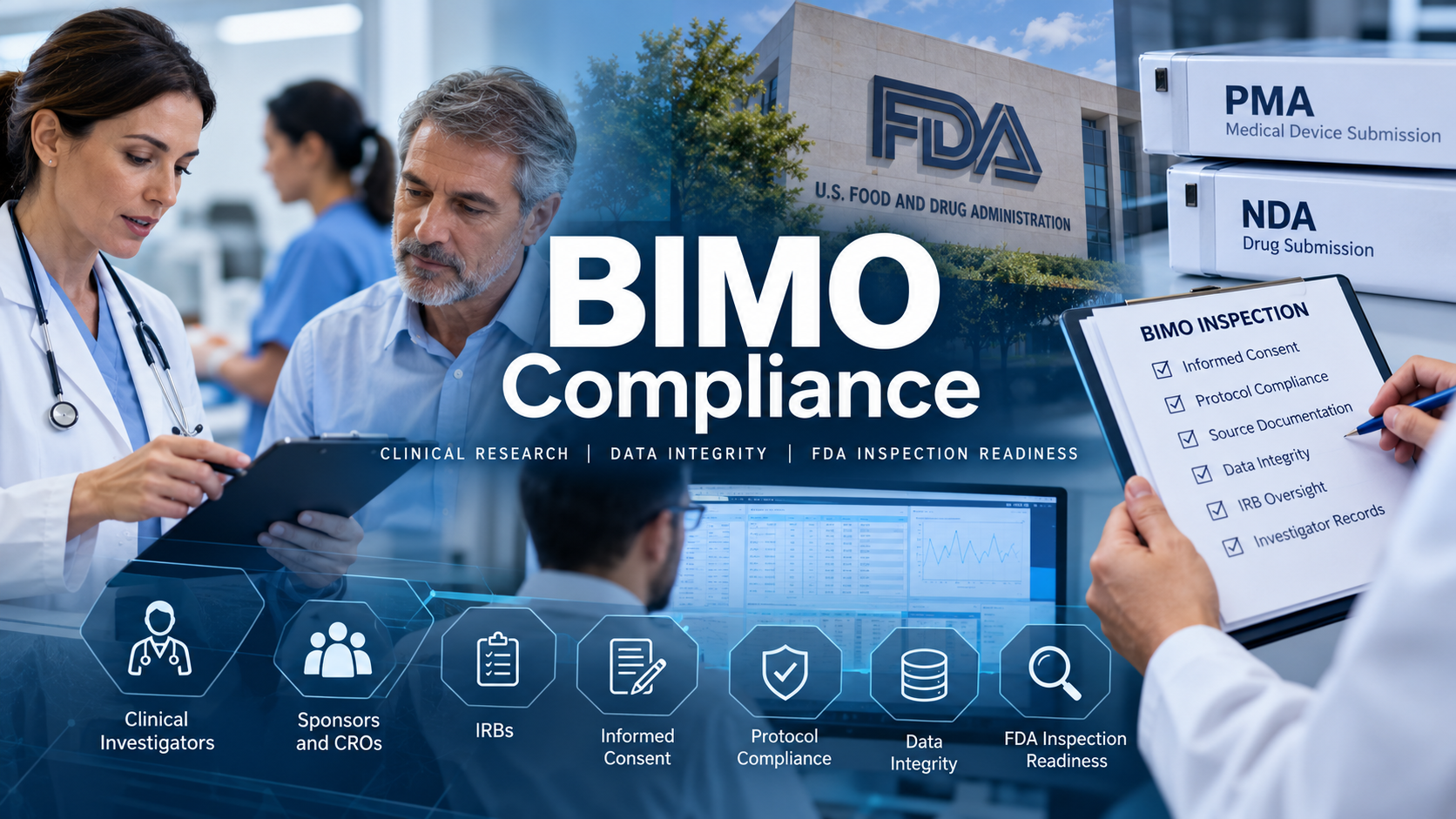
CIRG provides FDA Consulting for clinical research supporting medical device PMA applications and pharmaceutical NDA submissions. FDA’s Bioresearch Monitoring program evaluates whether clinical data are accurate, reliable, and suitable for regulatory decision-making. It also protects the rights, safety, and welfare of research subjects. Key areas include clinical investigators, sponsors and CROs, IRBs, informed consent, protocol compliance, monitoring, and data integrity. CIRG helps organizations assess BIMO readiness before FDA audits pivotal study data or inspects research sites. Our approach focuses on traceability, oversight, source documentation, protocol execution, and the evidence supporting PMA or NDA review.
Why CIRG Is Different: Device and Drug BIMO Expertise
CIRG brings BIMO experience across both medical device and pharmaceutical clinical research, supporting studies tied to PMA and NDA submissions. That dual perspective helps us recognize how investigator oversight, sponsor controls, IRB responsibilities, protocol compliance, informed consent, and data integrity differ across product types. Our FDA Consulting approach connects clinical research requirements with the broader device and drug regulatory frameworks, giving clients a more complete view of inspection risk and submission readiness.
Understanding FDA Bioresearch Monitoring (BIMO)
FDA’s Bioresearch Monitoring program evaluates clinical research supporting regulated product development and marketing applications. BIMO has two central objectives. It protects the rights, safety, and welfare of human research subjects. It also verifies the quality, accuracy, and reliability of data submitted to FDA. The program applies across product areas, including medical devices and human drugs. FDA conducts inspections of clinical investigators, sponsors, CROs, IRBs, sponsor-investigators, and other regulated research entities. Compliance Programs 7348.809, 7348.810, and 7348.811 provide inspection instructions for key BIMO activities. CIRG provides FDA Consulting that connects these requirements with PMA and NDA development programs. Our reviews focus on study oversight, regulatory records, protocol execution, human subject protection, and data integrity. Effective BIMO preparation should demonstrate that clinical evidence remains credible from source documentation through the final regulatory submission.
BIMO for Medical Device PMA Clinical Studies
Clinical evidence can form a critical part of a medical device Premarket Approval application. FDA may conduct BIMO inspections to verify data submitted in a PMA before making safety and effectiveness decisions. Investigators compare clinical source records with information submitted by the sponsor to FDA. They also evaluate compliance with the IDE regulations and human subject protection requirements. Important regulations include 21 CFR Parts 50, 56, and 812. FDA may inspect clinical investigators, sponsors, IRBs, and supporting research operations when necessary. CIRG FDA Consulting helps device companies assess whether their pivotal clinical studies can withstand this scrutiny. We examine source documentation, protocol adherence, investigator oversight, monitoring, IRB records, informed consent, and sponsor controls. A successful PMA strategy requires more than statistically persuasive results. The underlying study conduct and documentation must also demonstrate reliable, traceable, and regulatory-compliant clinical evidence.
Clinical Investigator Responsibilities for Device Studies
Clinical investigators conducting investigational device studies carry direct responsibility for study conduct at their sites. They must follow the signed investigator agreement, investigational plan, applicable FDA regulations, and IRB requirements. Investigators also oversee informed consent, subject protection, device accountability, records, and required reports. Delegating study tasks does not eliminate investigator responsibility for appropriate oversight. FDA BIMO inspections may compare source records with case report forms and sponsor-submitted PMA data. Investigators should therefore maintain complete and consistent documentation throughout the study. CIRG provides FDA Consulting to evaluate investigator-site readiness before FDA conducts an inspection or data audit. We review regulatory files, source documentation, protocol deviations, consent records, device accountability, and investigator supervision. Weak documentation can undermine otherwise valid clinical results. Strong investigator controls help protect subjects while preserving the credibility of evidence that supports a PMA regulatory decision.
Sponsor and CRO Oversight for PMA Studies
Medical device sponsors remain responsible for appropriate oversight of investigational studies used to support PMA applications. Responsibilities can include selecting qualified investigators, providing study information, monitoring investigations, maintaining records, and addressing investigator noncompliance. Sponsors frequently delegate operational activities to CROs, but delegation must remain clear and controlled. FDA can inspect both sponsors and CROs through BIMO Compliance Program 7348.810. Inspectors may examine monitoring practices, study management, protocol deviations, investigator communications, data handling, and corrective actions. CIRG FDA Consulting helps sponsors evaluate whether oversight activities provide credible evidence of control. We assess monitoring systems, delegation records, escalation processes, study documentation, and sponsor responses to emerging risks. Effective oversight should identify problems early rather than discover them during PMA review. A well-controlled sponsor system protects subjects, strengthens clinical data integrity, and supports confidence in the evidence submitted to FDA.
BIMO for Drug NDA Clinical Studies
FDA uses BIMO activities to evaluate clinical research supporting pharmaceutical development and New Drug Applications. Drug studies conducted under an IND must comply with applicable Good Clinical Practice requirements and 21 CFR Part 312. NDA requirements appear in 21 CFR Part 314. During BIMO inspections, FDA may evaluate whether clinical data accurately represent study conduct and support regulatory decision-making. Human subject protection remains equally important. Clinical investigators, sponsors, CROs, and IRBs can all become inspection subjects. CIRG provides FDA Consulting for organizations preparing clinical evidence that may support an NDA. We evaluate oversight, investigator records, protocol execution, informed consent, monitoring, safety reporting, and data integrity. Strong NDA preparation should address BIMO risks before FDA begins application review. Clinical results lose regulatory value when FDA cannot verify their reliability. Building inspection-ready evidence throughout development provides a stronger foundation for the final marketing application.
Clinical Investigator Responsibilities for Drug Studies
Drug clinical investigators must conduct studies according to the investigational plan, signed commitments, and applicable FDA regulations. Their responsibilities include subject protection, informed consent, protocol compliance, investigational drug control, accurate records, and required safety reporting. Investigators must also provide appropriate supervision over staff performing delegated study activities. FDA conducts clinical investigator inspections under BIMO Compliance Program 7348.811. Inspectors may review source records, case report forms, consent documentation, drug accountability, protocol deviations, and communications with sponsors and IRBs. CIRG FDA Consulting helps investigator sites evaluate these controls before inspection. We look for inconsistencies between source data, reported results, and regulatory documentation. A recurring problem or weak explanation can lead FDA to examine additional records. Maintaining accurate, contemporaneous, and traceable evidence helps investigators demonstrate that subjects received appropriate protection and that clinical data supporting an NDA remain reliable.
Sponsor and CRO Oversight for NDA Studies
Drug sponsors carry broad responsibility for the initiation, management, and oversight of clinical investigations conducted under an IND. Sponsors select qualified investigators, provide study information, monitor investigations, maintain required records, and address significant noncompliance. CROs may perform delegated sponsor activities, but responsibilities should remain clearly documented. FDA conducts sponsor and CRO inspections under Compliance Program 7348.810. Investigators can examine monitoring practices, safety reporting, protocol deviations, data management, investigator selection, and corrective actions. CIRG provides FDA Consulting to assess whether sponsor oversight can withstand BIMO scrutiny before NDA submission or review. We evaluate monitoring systems, escalation pathways, CRO governance, study records, and management responses to clinical risks. Effective oversight requires more than collecting monitoring reports. Sponsors should demonstrate that identified problems received timely investigation, appropriate correction, and meaningful follow-up before those issues affect subject safety or clinical data credibility.
IRB Responsibilities and Human Subject Protection
Institutional Review Boards provide independent oversight of FDA-regulated clinical investigations involving human subjects. Their primary role centers on protecting participant rights, safety, and welfare. FDA requirements for IRBs appear primarily in 21 CFR Part 56, while Part 50 addresses informed consent and human subject protection. IRBs review research protocols, consent materials, proposed changes, and continuing study information when required. They must also maintain appropriate records and written procedures. FDA conducts BIMO inspections of IRBs under Compliance Program 7348.809. CIRG FDA Consulting helps sponsors, investigators, and research organizations evaluate how IRB oversight integrates with their study controls. We review approvals, correspondence, reporting, protocol changes, consent documentation, and escalation of significant noncompliance. Gaps between investigator actions, sponsor knowledge, and IRB records can create substantial BIMO concerns. Effective coordination helps demonstrate that participant protection remained active throughout the clinical investigation.
Informed Consent and Protocol Compliance
Informed consent and protocol compliance sit at the center of FDA’s human subject protection framework. Investigators must obtain legally effective informed consent before involving subjects in regulated research, except where specific exceptions apply. Consent should reflect the approved study and provide required information under 21 CFR Part 50. Study personnel must also conduct research according to the approved protocol and investigational plan. Significant deviations can affect subject safety and clinical data reliability. CIRG provides FDA Consulting to assess consent processes, protocol execution, deviation management, and supporting documentation. We look for expired forms, missing signatures, inconsistent dates, unauthorized changes, and inadequate deviation explanations. FDA investigators may trace these issues across source records, IRB documentation, and sponsor communications. Strong compliance requires more than a signed form. The records should demonstrate that participants received appropriate information and that investigators consistently followed the approved research plan.
Clinical Data Integrity and Source Documentation
Clinical data submitted to FDA must remain accurate, reliable, traceable, and supported by underlying records. BIMO inspections test that foundation by comparing reported study results with source documentation maintained at research sites and by sponsors. Source records may include medical records, laboratory results, device data, drug accountability information, electronic systems, and other original study evidence. FDA also expects appropriate controls over computerized systems used to create, modify, maintain, or transmit clinical data. CIRG FDA Consulting evaluates whether study records create a defensible audit trail from the original observation through the regulatory submission. We examine missing data, unexplained changes, inconsistent records, electronic controls, and reconciliation processes. Data integrity problems can affect far more than individual data points. They can cause FDA to question the credibility of a clinical site, study, or entire submission supporting a PMA or NDA.
Preparing for an FDA BIMO Inspection
BIMO inspection readiness should begin before FDA issues an inspection notice. Research organizations need complete records, clear responsibilities, controlled document retrieval, and personnel who understand their study activities. Preparation should cover protocol compliance, informed consent, IRB documentation, monitoring, safety reporting, investigational product accountability, source records, and data integrity. Sponsors should also confirm that CRO delegation and oversight remain traceable. CIRG provides FDA Consulting and mock BIMO inspection support for PMA and NDA clinical programs. We follow records across functions, challenge inconsistent explanations, and test whether submitted data match underlying evidence. Staff interviews can reveal weaknesses that document reviews alone may miss. Effective preparation should not create rehearsed answers. It should verify that the study was conducted correctly and that personnel can explain their responsibilities accurately. Finding these gaps before FDA arrives gives management time to address genuine compliance weaknesses.
FDA BIMO Compliance Support
CIRG provides FDA Consulting across the clinical research systems that support PMA and NDA submissions. Engagements can address clinical investigator readiness, sponsor oversight, CRO controls, IRB interactions, informed consent, protocol compliance, source documentation, and data integrity. We can review one specific study or evaluate a broader clinical quality system. Support may also include mock BIMO inspections, document tracing, interview preparation, and corrective action assessment. Our approach focuses on the evidence FDA investigators actually examine rather than generic clinical research checklists. Device and drug programs require different regulatory frameworks, so CIRG evaluates each study within its applicable requirements. PMA programs may involve IDE and device regulations, while NDA programs commonly involve IND requirements and drug development controls. This dual perspective helps organizations identify regulatory weaknesses before FDA questions the reliability of clinical evidence supporting a marketing application.
BIMO Compliance Through an FDA Inspection Perspective
BIMO compliance becomes clearer when viewed through the path an FDA investigator may follow. An inspection rarely stays confined to one document or one department. A protocol deviation can lead to informed consent, investigator oversight, monitoring, IRB reporting, and data integrity questions. Inconsistent source data may expand the review into sponsor controls or submission accuracy. CIRG FDA Consulting applies this inspection perspective when evaluating clinical research programs supporting PMAs and NDAs. We examine connections between records, decisions, responsibilities, and reported clinical results. Particular attention goes to repeated deviations, weak monitoring, incomplete source documentation, delayed reporting, and unresolved discrepancies. FDA conducts both routine and directed BIMO inspections, including inspections linked to issues identified during application review. Preparing for those connections helps organizations understand how seemingly isolated weaknesses can affect the regulatory credibility of an entire clinical study or marketing submission.
Engage CIRG for BIMO Inspection Readiness
CIRG provides FDA Consulting for clinical research programs supporting both medical device PMA applications and pharmaceutical NDA submissions. Our support can include BIMO gap assessments, clinical investigator readiness, sponsor and CRO oversight reviews, IRB compliance, informed consent, protocol compliance, source documentation, data integrity, and mock FDA BIMO inspections. We evaluate clinical research through an FDA inspection perspective and focus on the records, controls, and decisions that support regulatory credibility. Whether you are preparing a pivotal study, approaching PMA or NDA submission, or responding to inspection risk, CIRG can help identify weaknesses before FDA does.
Contact CIRG to discuss BIMO readiness, clinical compliance, or a mock FDA BIMO inspection.