
FDA Dietary Supplement Consultant
Entering the U.S. dietary supplement market requires careful planning before products are shipped or promoted. An FDA Dietary Supplement Consultant helps identify regulatory issues early and establish a clear compliance pathway. We begin by confirming product eligibility, ingredients, intended use, and proposed claims. Next, we review labelling and promotional materials for disease or drug claims and required notifications. We then address facility registration, U.S. Agent requirements, import obligations, and Prior Notice, where applicable. Manufacturing operations must also meet dietary supplement CGMP requirements under 21 CFR Part 111. Inspection readiness becomes a priority once the product and regulatory foundation are sound. Post-market responsibilities continue after distribution, including complaint handling and serious adverse event reporting. Working with an FDA Dietary Supplement Consultant helps foreign manufacturers understand Agency expectations, reduce avoidable compliance risks, and prepare for entry into the U.S. market with confidence.
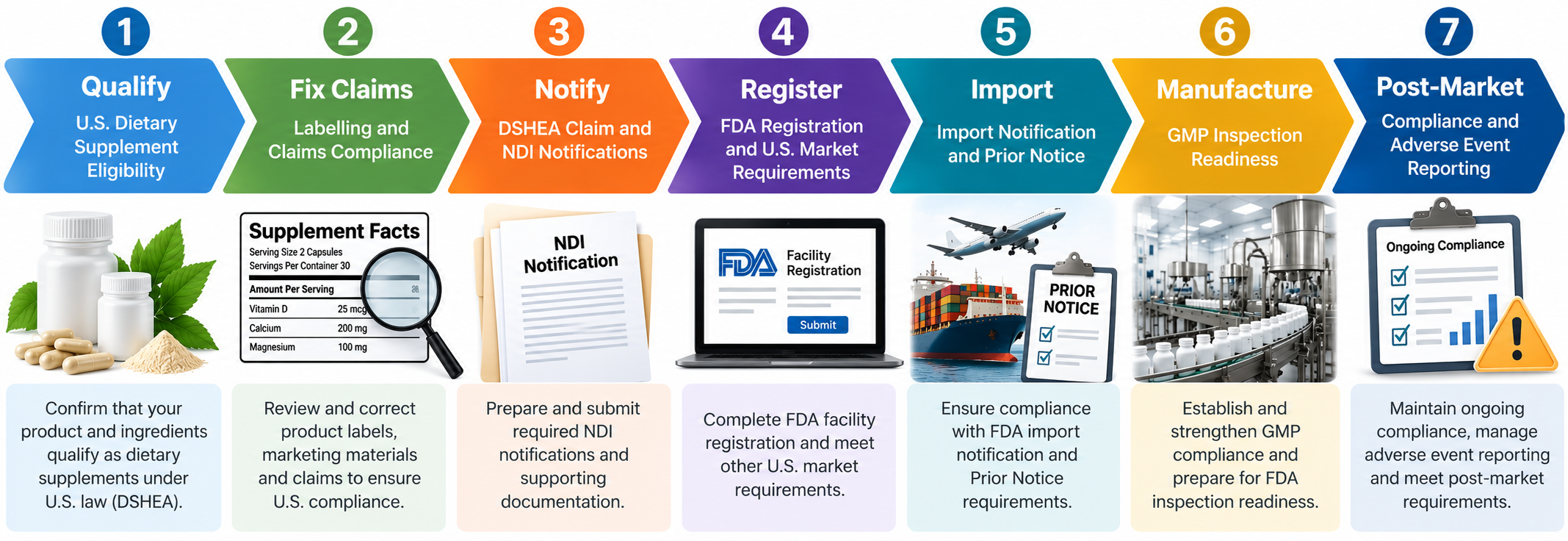
Key Steps to U.S. Dietary Supplement Compliance
Successful U.S. market entry follows a clear sequence, and each step builds on the one before it. First, we confirm that the product qualifies as a dietary supplement and review ingredients, intended use and dosage form. Next, we assess labelling, websites and promotional materials for claims that may create drug or disease concerns. Required DSHEA claim notifications and NDI submissions follow, where applicable. We then address facility registration, U.S. Agent responsibilities, import requirements and Prior Notice. After these regulatory foundations are complete, attention shifts to manufacturing compliance and Agency inspection readiness under applicable CGMP requirements. Post-market systems must also support complaint handling, serious adverse event reporting and continued claims oversight. Our FDA Dietary Supplement Consulting approach keeps these activities in the correct order, helping foreign manufacturers reduce avoidable delays, control regulatory risk and prepare for sustainable U.S. distribution with confidence.
U.S. Dietary Supplement Eligibility
Before entering the U.S. market, confirm that the product legally qualifies as a dietary supplement. The Agency defines supplements as products intended for ingestion that contain qualifying dietary ingredients and supplement the diet. We review vitamins, minerals, botanicals, amino acids and other permitted ingredient categories. Dosage form, intended use and presentation also matter. A product represented as conventional food may not qualify. The label must identify the product as a dietary supplement or equivalent. We also assess drug or biologic exclusions and whether ingredients are new dietary ingredients. This eligibility review establishes the regulatory pathway before further compliance work begins.
Labelling and Claims Compliance
Labelling and claims can determine whether the Agency treats a product as a dietary supplement or an unapproved drug. We review product labels, websites, brochures, publications and other promotional materials for regulatory risk. Structure/function claims may describe normal body structure or function, but firms need substantiation and the required disclaimer. Disease claims cannot state or imply diagnosis, mitigation, treatment, cure or prevention. Health claims and nutrient content claims follow separate requirements. Context matters because surrounding language can change a statement’s regulatory meaning. Our FDA Dietary Supplement Consulting identifies problematic wording early and helps align claims with the lawful marketing pathway.
Supplement Facts and Label Requirements
A compliant dietary supplement label requires more than acceptable marketing claims. We review the principal display panel, statement of identity, net quantity, Supplement Facts panel, ingredient declaration, allergen statements, and manufacturer or distributor information. We also confirm the required domestic address or telephone number for serious adverse event reporting, where applicable. Formatting matters, including serving size, ingredient naming, units, daily values, footnotes and placement of required information. Our FDA Dietary Supplement Consulting compares each label against applicable requirements under 21 CFR Part 101 and Agency guidance. Correcting these details before printing helps avoid relabelling costs, import delays and compliance problems.
DSHEA Claim and NDI Notifications
Once claims are compliant, we determine which Agency notifications apply. Certain structure/function, general well-being and classical nutrient deficiency claims require notification no later than 30 days after first marketing. The firm must possess substantiation that each claim is truthful and not misleading and use the required disclaimer. We assess every dietary ingredient for NDI status. When an NDI notification is required, the manufacturer or distributor must submit it at least 75 days before interstate commerce. The notification must provide the basis for concluding that the supplement containing the NDI will reasonably be expected to be safe under conditions of use.
FDA Registration and U.S. Market Requirements
Facilities that manufacture, process, pack or hold dietary supplements for U.S. consumption generally must register with the Agency unless an exemption applies. Foreign facilities must designate a U.S. Agent who resides or maintains a place of business in the United States. Registration also requires an Agency-accepted unique facility identifier, currently including DUNS. Required registrations must be renewed between 1 October and 31 December of each even-numbered year. We verify facility information, activities, contacts and U.S. Agent details before submission. Registration does not mean that the Agency approved the facility, product or label. It establishes the facility within the regulatory system.
FDA Import Notification and Prior Notice
Dietary supplements and dietary ingredients imported into the United States generally require Prior Notice before arrival, unless an exemption applies. The Agency uses this information to review food shipments and target examinations. Timing depends on transportation. Prior Notice is generally due at least two hours before road arrival, four hours by rail or air, and eight hours by water. Importers must also address applicable Foreign Supplier Verification Program requirements. Dietary supplements have specialised FSVP provisions under 21 CFR 1.511. We confirm the importer, foreign supplier, entry information and compliance records before shipment. Noncompliant products may face examination, detention or refusal.
FDA GMP Inspection Readiness
After product eligibility, claims, notifications and registration are addressed, GMP inspection readiness becomes a major priority. Dietary supplement manufacturers must comply with 21 CFR Part 111 and applicable Part 117 requirements. We evaluate quality control operations, specifications, component identity, supplier controls, master manufacturing records, batch records, laboratory controls, sanitation, complaints and recordkeeping. Documentation alone is not enough. Actual manufacturing practices must consistently match approved procedures and specifications. Our FDA Dietary Supplement Consulting identifies gaps, prioritises corrective actions and prepares personnel for Agency interaction. A mock FDA inspection can then test facility readiness, document retrieval, interviews and management responses before inspection.
Post-Market Compliance and Adverse Event Reporting
Compliance continues after a dietary supplement reaches the U.S. market. The responsible person named on the label must maintain systems for receiving and evaluating adverse event reports. Product labels must provide a domestic address or domestic telephone number for reporting serious adverse events. Qualifying serious adverse event reports generally must reach the Agency within 15 business days. New medical information received within one year also requires timely follow-up reporting. Adverse event records must be retained for six years. We also review complaints, trends, safety signals, labelling changes and claims. Strong post-market controls help identify problems before they become enforcement issues.
Why Our FDA Dietary Supplement Consultant Is Different
Our FDA Dietary Supplement Consultant brings something many regulatory advisers cannot offer: direct experience from inside the Agency. Andrew Paeng served as an FDA Compliance Officer and worked on dietary supplement compliance and enforcement matters, giving him practical insight into how the Agency evaluates products, claims, records and manufacturing operations. That experience goes beyond simply reading regulations or guidance documents. We understand how investigators and compliance officers identify regulatory risk, develop observations and evaluate a firm’s response. This perspective helps us recognise problems earlier and focus attention on issues most likely to concern the Agency. We review eligibility, labelling, claims, notifications, manufacturing systems and inspection readiness as connected parts of one compliance programme. The result is practical FDA Dietary Supplement Consulting built around real Agency expectations, not just a regulatory checklist.
Ready for the U.S. Market?
Entering the U.S. dietary supplement market can open major opportunities, but only when the regulatory foundation is right. Our FDA Dietary Supplement Consulting helps you move forward with a clear, practical plan. We review product eligibility, claims, notifications, registration, import requirements, GMP readiness and post-market obligations before problems reach the Agency. If gaps exist, we identify them early and help your team correct them efficiently. For manufacturers preparing to export, we can also conduct a mock FDA inspection to test records, procedures, staff responses and inspection readiness under realistic conditions. The objective is not simply to complete paperwork. It is to help you enter the market correctly, stay compliant and remain ready for Agency scrutiny as your business grows. If you are serious about the U.S. market, start with a regulatory strategy built on experience, not guesswork, from the beginning.
FAQ
Does FDA approve dietary supplements before marketing?
No. The FDA does not approve dietary supplements for safety or effectiveness before they are marketed. Manufacturers and distributors are responsible for ensuring that products are safe, properly labelled, and compliant with applicable law before sale. Certain requirements, such as NDI notifications, may apply before marketing.
Do foreign manufacturers need FDA registration?
Generally, yes. A foreign facility that manufactures, processes, packs or holds dietary supplements for U.S. consumption must register with the Agency unless an exemption applies. Registration does not mean that the Agency approved the facility or its products.
Do I need a U.S. Agent?
If your foreign facility is required to register with the Agency, you must designate a U.S. Agent who resides or maintains a place of business in the United States. The U.S. Agent serves as a communication link between the foreign facility and the Agency.
What is an NDI notification?
An NDI notification is a premarket safety notification for certain new dietary ingredients. An NDI generally means a dietary ingredient not marketed in the United States in a dietary supplement before 15 October 1994. When notification is required, it must generally be submitted at least 75 days before introducing the supplement into interstate commerce.
Does FDA review dietary supplement labels?
The FDA does not approve dietary supplement labels before marketing. However, it may review labels, websites, and other labelling during inspections, import review, or compliance activities. The FDA can take action when labelling is false, misleading, improperly formatted, or contains claims that cause the product to be regulated as a drug.
What is Prior Notice?
Prior Notice is advance notification to the Agency that a food shipment, including dietary supplements and dietary ingredients, is being imported into the United States. It allows the Agency to review shipment information before arrival and determine whether examination is appropriate. Unless an exemption applies, Prior Notice must be submitted within specified timeframes before the shipment reaches the United States.
Can FDA inspect a foreign dietary supplement facility?
Yes. The Agency conducts inspections of foreign facilities that manufacture, process, pack or hold food, including dietary supplements intended for the U.S. market. These inspections evaluate compliance with applicable U.S. requirements and can influence whether products are permitted entry into the United States.
What disclaimer is required for dietary supplement structure/function claims?
“These statements have not been evaluated by the Food and Drug Administration. This product is not intended to diagnose, treat, cure, or prevent any disease.”
Who Regulates Dietary Supplement Advertising?
The FTC has primary responsibility for dietary supplement advertising, while FDA has primary responsibility for dietary supplement labelling. Both agencies can take enforcement action when claims are false, misleading, or otherwise unlawful.
Disclaimer
CIRG is an independent regulatory consulting firm and is not affiliated with, endorsed by, or acting on behalf of the U.S. Food and Drug Administration. Information on this page is provided for general regulatory purposes and does not constitute legal advice or guarantee Agency acceptance, product entry, registration, or inspection outcomes. Regulatory requirements may vary depending on the product, ingredients, claims, manufacturing activities, and U.S. import pathway.
You do not need the DSHEA structure/function disclaimer on this consulting page unless the page itself makes a qualifying structure/function claim about a dietary supplement product. That statutory disclaimer applies to qualifying claims in dietary supplement labelling, not simply because a webpage discusses dietary supplement consulting.