
FDA Inspection Playbook
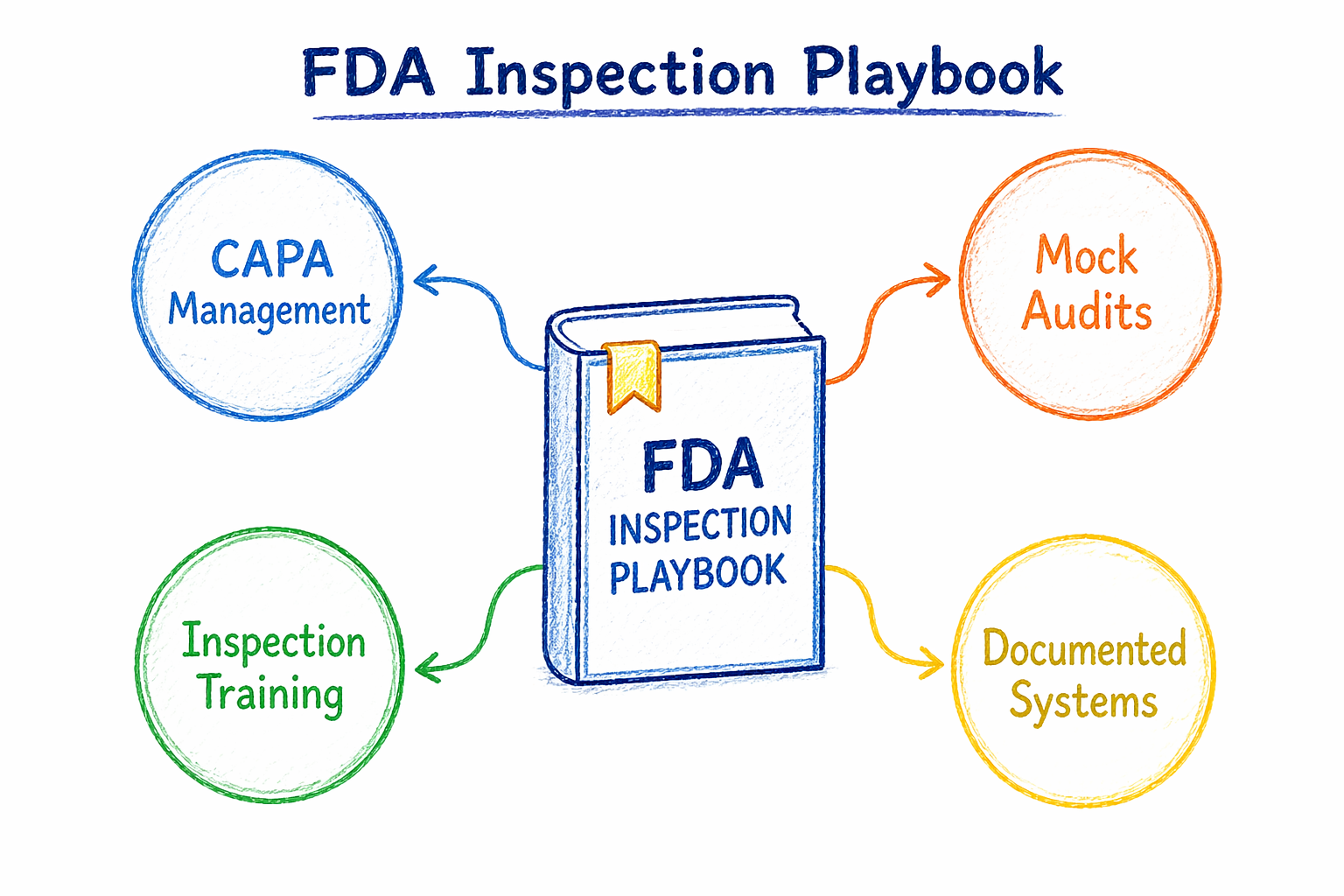
An FDA inspection is not based on your internal timeline, it is driven by risk signals, compliance history, and regulatory focus. This FDA Inspection Playbook outlines a practical approach to inspection preparation based on how FDA investigators actually assess systems, data, and decision-making. It is not a checklist. It emphasizes control, consistency, and the ability to demonstrate compliance under scrutiny. From managing interactions to supporting decisions with accurate records, this playbook prepares your organization to operate confidently during an FDA inspection.
FDA Inspection Strategy and FDA Consulting
An FDA inspection does not happen on your schedule. It is driven by risk, compliance history, and regulatory priorities—not your internal readiness. While some frameworks reference inspection cycles, FDA operates based on risk signals and real-time intelligence. An FDA inspection playbook is not a checklist. It is a controlled operating model. It defines how your systems function under pressure, how your data supports decisions, and how your personnel respond when challenged. Companies that rely on timing or past inspection gaps create unnecessary exposure. Inspection readiness means operating in a constant state of control—not reacting when FDA arrives.
Who Is FDA Office of Inspections and Investigations (OII)
The Office of Inspections and Investigations (OII) is the operational enforcement arm of FDA. This is the group that conducts inspections, collects evidence, and evaluates compliance across regulated industries.
OII operates globally and continuously. Their role is not limited to facility inspections—they investigate complaints, monitor imports, and support enforcement actions.
Understanding OII is not optional. This is the team that will evaluate your systems in real time.
OII Conducts Inspections That Drive Regulatory Action
OII investigators assess manufacturing operations, quality systems, and records against regulatory requirements. Inspections are evidence-driven. Findings can result in observations, recalls, import alerts, or enforcement action.
OII Investigates Beyond the Facility
OII activities extend beyond manufacturing sites. Investigations may involve complaints, distribution channels, and potential compliance failures. When needed, they coordinate with enforcement units for further action.
Screens and Controls What Enters the U.S. Market
OII reviews imported products at ports of entry. Noncompliance can result in detention, refusal, or market access restrictions.
Operates Continuously and Globally
OII operates across dozens of countries and throughout the United States. Oversight is constant. Manufacturers should assume regulatory visibility at all times.
OCI
A separate organization—the Office of Criminal Investigations (OCI)—handles criminal matters such as fraud or falsification. If OCI is involved, the situation has escalated beyond routine inspection.
Who Is Subject to FDA Inspection?
FDA inspections apply to any entity involved in the manufacturing, processing, packing, holding, or distribution of FDA-regulated products. This includes pharmaceutical manufacturers, medical device companies, combination product firms, contract manufacturers, and specification developers. It also extends to testing laboratories, component suppliers, and importers whose activities impact product quality and compliance.
FDA authority is not limited to domestic firms. Foreign manufacturers that distribute products into the United States are equally subject to inspection. If your operations affect the safety, identity, strength, quality, or purity of a regulated product, FDA has the authority to inspect your facility and review your records.
Pharmaceutical Manufacturers
Regulated under 21 CFR Parts 210, 211, and 212 (CGMP for drugs). FDA inspections are typically conducted under Compliance Program 7356.002 (Drug Manufacturing Inspections). Investigators assess production controls, laboratory systems, data integrity, and CAPA to ensure drugs meet safety, identity, strength, quality, and purity requirements.
Biologics and Biotechnology Companies
Regulated under 21 CFR Parts 600–680 (Biologics) and Parts 210/211 where applicable. FDA inspections are conducted under Compliance Program 7356.002 (Drug CGMP) along with biologics-specific programs. Focus includes sterility assurance, process validation, contamination control, and consistency of complex biological products.
Combination Product Manufacturers
Regulated under 21 CFR Part 4 (Combination Products), with requirements from 21 CFR Parts 210/211 (drug) and/or Part 820 (QMSR). FDA inspections follow the applicable compliance program (e.g., CP 7356.002 for drug-led, CP 7382.850 for device-led). Focus includes integrated quality systems, design, process validation, CAPA, and consistent control across drug and device components.
Dietary Supplement Manufacturers
Regulated under 21 CFR Parts 111 (CGMP) and 101 (Labeling). FDA inspections follow CP 7321.008. Investigators evaluate manufacturing controls, testing, specifications, recordkeeping, labeling compliance, claims substantiation, adverse event reporting, and control over packaging and distribution to ensure product identity, purity, strength, and composition.
Medical Device Manufacturers
Regulated under 21 CFR Part 820 (Quality Management System Regulation, QMSR). FDA inspections follow Compliance Program 7382.850. Investigators evaluate design controls, risk management, CAPA, production controls, and complaint handling to determine whether the quality system is controlled and capable of consistently producing safe and effective devices.
Bioresearch Monitoring (BIMO) – Clinical and Research Oversight
Regulated under 21 CFR Parts 50, 56, 312, and 812. FDA inspections fall under the BIMO program, including CP 7348.811 (clinical investigators), 7348.810 (sponsors/CROs), and 7348.809 (IRBs). Focus is on subject protection, data integrity, protocol adherence, and accurate reporting.
In Vitro Diagnostic (IVD) Manufacturers
In the U.S., IVDs are regulated under 21 CFR Part 820 (QMSR), with inspections conducted under Compliance Program 7382.850. FDA evaluates design, performance, risk management, and post-market controls. In Europe, IVDs fall under EU IVDR (EU 2017/746), with Notified Bodies overseeing conformity, performance evaluation, and quality system compliance.
Other FDA-Regulated Industries
FDA also regulates cosmetics, OTC drugs, tobacco, veterinary drugs, animal food, laser products, radiation-emitting products, imports, and certain human cells, tissues, and cellular and tissue-based products under Section 361 of the Public Health Service Act. Inspections focus on safety, labeling, manufacturing controls, and regulatory compliance.
FDA Roles and Responsibilities Explained
Investigators and Reviewers (Consumer Safety Officers or Engineers)
FDA investigators, often titled Consumer Safety Officers (CSOs) or engineers, conduct inspections of regulated facilities and assess compliance with applicable regulations. They review quality systems, manufacturing operations, and records to determine whether products are safe and controlled. They collect evidence, document findings, and may issue Form FDA 483 observations. Reviewers, who may also be CSOs or engineers within FDA centers, evaluate submissions, data, and inspection outcomes to support regulatory decisions, approvals, or enforcement actions.
Inspectors (Consumer Safety Inspectors)
Consumer Safety Inspectors (CSI) perform more limited, task-specific activities compared to investigators. Their work often includes sample collection, basic inspections, and field assignments under defined scope. They may support broader inspectional efforts but generally do not lead complex system-based inspections. Inspectors focus on execution—following procedures, collecting evidence, and ensuring proper handling of samples or products during routine or targeted regulatory activities.
Laboratory Scientists
FDA laboratory scientists analyze samples collected during inspections or investigations to support regulatory actions. They perform testing to confirm product identity, detect contamination, or verify compliance with specifications. Their work provides scientific evidence used in enforcement decisions, including recalls or legal actions. Laboratory findings must be accurate, validated, and defensible, as they often serve as critical support in determining whether products are adulterated or misbranded.
What to Do When an FDA Investigator Arrives
You do not control when FDA arrives or how long the inspection will last. Duration is driven by what investigators find as they follow your records, systems, and responses. Your objective is not to “pass” the inspection—it is to demonstrate control, consistency, and credibility in real time.
Immediately activate your inspection protocol. Verify credentials, notify your internal team, and establish front room/back room control. Assign a trained escort and ensure all communication is managed through designated personnel. Every request must be tracked, reviewed, and fulfilled with accurate, complete records.
Do not guess, speculate, or provide unverified information. If something is unknown, state that you will confirm and follow up. Maintain discipline in communication—clear, concise, and factual. Investigators assess how your system performs under scrutiny. What they see during those first interactions often sets the tone for the entire inspection.
Contact our Former FDA Investigator Immediately When the FDA Arrives
Do not underestimate any FDA inspection. Even routine inspections can escalate quickly based on what investigators find. What appears simple at the start can expand in scope within hours.
Engaging a former FDA investigator during the inspection provides immediate, practical support. They understand how investigators think, how inspections evolve, and how to manage communication without creating unnecessary risk. They can help interpret requests, guide responses, and maintain control between your front room and back room.
This is not about reacting. It is about staying in control throughout the inspection. The right support helps you respond deliberately, avoid missteps, and keep your team aligned under pressure.
What to Do and Not to Do
Do
- Verify credentials and expect FDA Form 482
- Assign a trained escort
- Provide records promptly or explain delays
- Ask daily what was reviewed and noted
- Correct obvious issues when appropriate
What to Say
- “Let me verify and provide the correct record.”
- “We will retrieve that information.”
- “Our contact will coordinate this request.”
Do Not
- Refuse entry or delay access
- Interfere with inspection activities
- Assume scope is fixed
- Restrict access to entitled records
- Do not block photography
Do Not Say
- “I think…”
- “Probably…”
- “We usually…”
- “That’s how we’ve always done it.”
How to Set Up Front Room and Back Room During an FDA Inspection
A structured front room/back room model is critical during an FDA inspection. It ensures control, consistency, and accuracy in all communications and document handling. The front room manages direct interaction with investigators, while the back room verifies information, prepares responses, and maintains alignment, preventing errors and reducing unnecessary risk.
Front Room (FDA-Facing Team)
The front room is the only point of direct interaction with FDA investigators. All communication must be controlled, consistent, and deliberate. A designated lead manages the discussion and determines who speaks, ensuring one clear voice at all times. Subject matter experts support only when needed and stay within scope. Every question is listened to carefully, clarified if necessary, and logged. Only verified, reviewed information is presented—nothing informal or speculative. If information is not immediately available, the response should be that it will be confirmed and provided. The front room sets the tone, demonstrating organization, discipline, and control throughout the inspection.

Back Room (Support and Control Team)
The back room operates behind the scenes to support the inspection with speed and control. This team manages document retrieval, verifies accuracy, and prepares all responses before anything is provided to FDA. Every request is tracked, prioritized, and reviewed for completeness and consistency. Subject matter experts, quality, and document control work together to ensure information is accurate and defensible. Any gaps or risks are identified and escalated internally before release. The back room prevents errors, avoids conflicting information, and ensures that only controlled, verified responses reach the front room and the investigator.

Minimum Roles During the FDA Inspection
- Executive Presence. Signals accountability and seriousness at the opening meeting.
- Receptionist. Controls initial interaction and activates the inspection protocol.
- Escort. Accompanies the investigator at all times.
- Runner (Document Coordinator). Transfers documents quickly and efficiently between the front room and back room. Reads the situation in real time and reports status, urgency, and investigator reactions to the back room leader to support controlled, timely responses.
- Front Room Leader. Leads all communication with FDA.
- Back Room Leader. Controls document flow and response accuracy.
- Scriber. Documents everything in real time.
- Subject Matter Experts (SMEs). Provide controlled, accurate technical responses.
Establish an Internal FDA Inspection Playbook and Train Your SMEs
An inspection playbook must be formalized as a controlled procedure, not an informal practice. It should clearly define roles, communication flow, escalation paths, and how requests are received, tracked, reviewed, and delivered. Every response must be controlled, verified, and aligned before reaching FDA. Subject matter experts (SMEs) must be trained on how to respond—not just what they know. They need to understand how FDA asks questions, how to stay within scope, and how to avoid speculation or overexplaining. Mock inspections and real-world scenarios are essential. They test execution under pressure, expose gaps in communication and coordination, and ensure the team can perform—not just document compliance.
Prepare Front Desk and Maintain SME Contacts
The inspection begins at the front desk. The first few minutes set the tone and can either establish control or create unnecessary risk. The receptionist must follow a defined protocol and avoid informal interaction. At the same time, access to subject matter experts (SMEs) must be controlled—no one engages with FDA unless authorized.
Reception Protocol
The receptionist should remain professional, calm, and brief. Do not engage in conversation or attempt to answer questions. Immediately notify the designated inspection lead and backup contacts. The only appropriate response is that the responsible person will be available shortly. This creates time to activate the inspection process and assemble the team.
FDA Forms 482, 483, 484, Affidavit
- FDA Form 482
Notice of Inspection. Official start of inspection. - FDA Form483
Inspectional Observations. Not a final determination. - FDA Form 484
Documents sample collection. - Affidavit
A formal sworn statement. Should be reviewed carefully before signing.
Conduct Annual or Biannual Mock FDA Inspections
Do not wait for FDA to evaluate your system. Mock inspections should be planned and executed regularly to test how your organization performs under real inspection conditions, not just how procedures appear on paper. This is where readiness is proven—not assumed.
Real-World Testing
Mock inspections must replicate FDA behavior, including unannounced arrival, real-time questioning, and document tracing across systems. This creates pressure and exposes how your team actually responds, communicates, and maintains control during an inspection.
Contact CIRG for FDA Inspection Readiness
If you are serious about inspection readiness, test your system before FDA does.