
OTC Drug Compliance
OTC drug compliance requires alignment across monograph status, active ingredients, indications, dosage forms, labeling, registration, listing, and CGMP controls. Products marketed without an approved NDA must satisfy section 505G of the FD&C Act and applicable OTC monograph conditions. Drug Facts labeling must meet 21 CFR 201.66, while establishment registration and drug listing follow 21 CFR Part 207. Manufacturing remains subject to 21 CFR Parts 210 and 211. CIRG provides FDA Consulting focused on regulatory pathway, monograph conformity, labeling claims, NDC/listing accuracy, CGMP readiness, and inspection risk before U.S. commercialization.
Over-the-Counter Monograph Compliance
Over-the-counter monograph drugs may be marketed without an approved NDA when they comply with section 505G of the FD&C Act. Each applicable monograph establishes conditions for active ingredients, indications, dosage forms, strengths, routes, labeling, and testing. FDA now updates these requirements through an administrative order process created by the CARES Act. Manufacturers must verify that each product remains within current monograph conditions and any applicable final orders. A formulation or claim outside those conditions may require a separate NDA pathway. CIRG provides FDA Consulting to evaluate monograph status, product claims, labeling, ingredients, dosage forms, and supporting documentation before commercialization. This technical review helps identify regulatory conflicts early and reduces the risk of marketing a product that FDA may consider outside the over-the-counter monograph framework.
Drug Facts Labeling Under 21 CFR 201.66
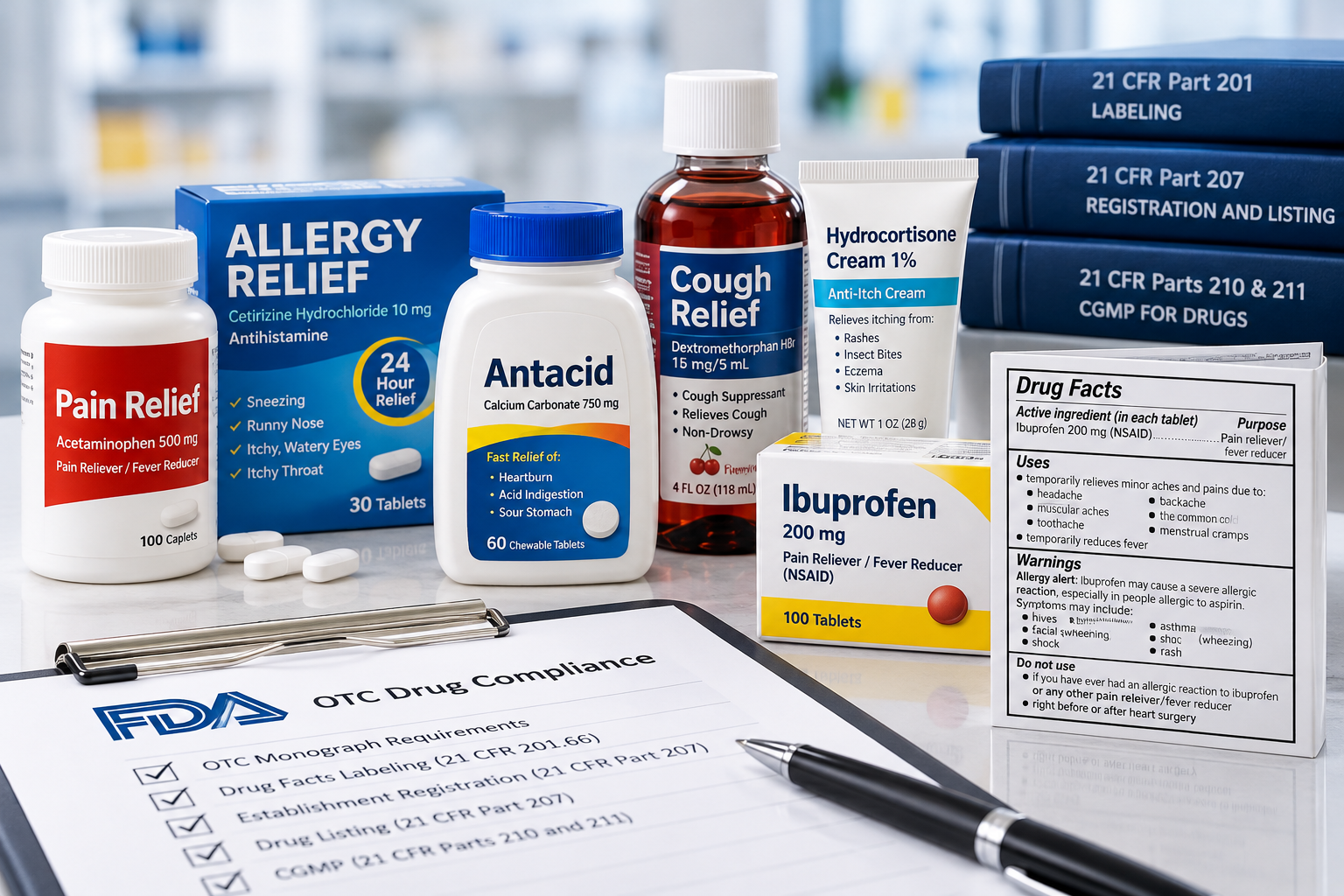
FDA requires standardized Drug Facts labeling for over-the-counter drug products under 21 CFR 201.66. The regulation controls both content and format, including headings, information order, typography, spacing, and presentation. Required sections commonly address active ingredients, purpose, uses, warnings, directions, other information, inactive ingredients, and contact information. The Drug Facts panel must also remain consistent with the applicable monograph or approved application. Labeling errors can create misbranding risk even when the formulation itself complies. CIRG provides FDA Consulting to review Drug Facts panels, principal display panels, claims, directions, warnings, and related product information. We also compare labeling against current monograph conditions and drug listing records. A technically correct label should align the formulation, intended use, regulatory pathway, and marketed claims without creating unsupported indications or contradictory information across packaging and electronic submissions.
FDA Establishment Registration, Drug Listing and NDC Requirements
Over-the-counter drug manufacturers must address FDA establishment registration and drug listing requirements under section 510 of the FD&C Act and 21 CFR Part 207. Covered manufacturing establishments generally register with FDA and renew their registration annually. Listed products require Structured Product Labeling submissions containing current product, ingredient, establishment, and labeling information. FDA also assigns labeler codes used in National Drug Code numbers. Registration, listing, and NDC information do not represent FDA approval, but inaccuracies can create compliance and import problems. CIRG provides FDA Consulting to review establishment registration, labeler code status, NDC configuration, listing records, and SPL content. We compare these records with actual manufacturing arrangements and current labeling. Companies should update information when formulations, labels, manufacturing sites, package configurations, or commercial relationships change because FDA relies on these records throughout regulatory oversight.
CGMP Requirements Under 21 CFR Parts 210 and 211
Over-the-counter drugs must comply with current good manufacturing practice requirements just like prescription drugs. 21 CFR Part 210 establishes general CGMP requirements, while Part 211 provides detailed controls for finished pharmaceuticals. These requirements address quality unit responsibilities, facilities, equipment, components, production, packaging, labeling, laboratory controls, records, distribution, and returned products. Monograph compliance does not replace CGMP obligations. A product can conform to an over-the-counter monograph yet still become adulterated if manufacturing fails applicable CGMP requirements. CIRG provides FDA Consulting to evaluate quality systems, batch records, laboratory controls, investigations, CAPA, supplier controls, validation, and management oversight. We focus on whether records demonstrate consistent control rather than procedural compliance alone. Manufacturers should be able to show that commercial batches meet established identity, strength, quality, purity, and other specifications throughout the product lifecycle.
OMUFA Facility Fees and Monograph Order Requests
The Over-the-Counter Monograph Drug User Fee Program, or OMUFA, supports FDA review and regulation of monograph drug activities. Qualifying monograph drug facilities and contract manufacturing organizations can owe annual facility fees. Companies submitting qualifying over-the-counter monograph order requests may also owe OMOR fees. OMUFA II covers fiscal years 2026 through 2030 and includes updated fee structures and payment schedules. Fee liability depends on facility activities and statutory definitions, not simply company size. Failure to address applicable fees can create regulatory and operational consequences. CIRG provides FDA Consulting to help companies understand how registration status, manufacturing arrangements, contract manufacturing, and monograph activities interact with OMUFA obligations. A company should confirm fee liability before restructuring manufacturing operations, adding contract facilities, or pursuing an administrative order request that changes an existing monograph.
Serious Adverse Event Reporting for Nonprescription Drugs
Nonprescription drug companies need systems for receiving, evaluating, documenting, and reporting serious adverse events. For products marketed without an approved application, the responsible person named on the label must submit qualifying serious adverse event reports to FDA. Reports received through the label’s address or telephone number generally require submission within 15 business days. New medical information received within one year can also trigger follow-up reporting. CIRG provides FDA Consulting to assess complaint intake, seriousness determinations, medical review, escalation, reporting timelines, and recordkeeping controls. These systems should distinguish routine product complaints from events that meet statutory reporting criteria while preserving information needed for investigation. Weak adverse event controls can create reporting failures and broader signals about product quality, labeling, or manufacturing performance. Those signals may attract additional FDA attention during inspection or compliance review.
Preparing for an FDA Over-the-Counter Drug Inspection
FDA can inspect over-the-counter drug manufacturers using the same CGMP framework applied to other human drug facilities. Inspection readiness should therefore extend beyond monograph and labeling review. Manufacturers need defensible evidence across quality, facilities and equipment, materials, production, packaging and labeling, and laboratory control systems. FDA Compliance Program CP 7356.002 provides the systems-based framework for many drug manufacturing inspections. Records should support investigations, deviations, batch disposition, laboratory results, supplier decisions, change control, CAPA, and management oversight. CIRG provides FDA Consulting and mock GMP inspection support to test these systems under realistic inspection conditions. We trace records across functions, challenge weak investigations, and evaluate how personnel explain actual practices. Effective preparation identifies issues before FDA converts them into observations, expands inspection scope, or questions whether management maintains a sustained state of control.
FDA OTC Drug Compliance Support
CIRG provides technical FDA Consulting for companies developing, manufacturing, labeling, listing, importing, or distributing over-the-counter drug products. Support can include monograph eligibility assessments, section 505G strategy, Drug Facts review, establishment registration, drug listing, NDC review, CGMP assessments, OMUFA considerations, adverse event systems, and FDA inspection readiness. Engagements can focus on one regulatory question or examine the full compliance framework supporting a product line. Our reviews connect formulation, claims, manufacturing controls, labeling, and FDA submissions rather than treating them as separate tasks. That distinction matters because inconsistencies across these areas can create unapproved new drug, misbranding, adulteration, or listing concerns. CIRG helps management identify those conflicts before commercialization, inspection, or import review. We then prioritize corrective actions according to regulatory significance rather than administrative convenience.
OTC Drug Compliance Through an FDA Inspection Perspective
Over-the-counter drug compliance becomes more meaningful when viewed through an FDA inspection and enforcement perspective. An investigator may begin with a batch record, complaint, laboratory result, label, or registration record and follow the evidence into connected systems. A monograph-compliant formulation does not protect a company from findings involving CGMP, misbranding, data integrity, listing, or adverse event reporting. CIRG FDA Consulting evaluates these connections before they become regulatory problems. We examine whether product claims match monograph conditions, listings match marketed labels, manufacturing records support release decisions, and investigations address recurring quality signals. Particular attention goes to issues that may expand the inspection scope or suggest systemic control failures. This perspective helps companies move beyond checklist compliance and understand how FDA may evaluate the total regulatory picture when determining whether regulatory or enforcement action warrants consideration.
Engage CIRG for OTC Drug Compliance
CIRG provides FDA Consulting for companies developing, manufacturing, labeling, listing, or distributing over-the-counter drug products in the U.S. market. Our support can include monograph eligibility review, Drug Facts labeling, establishment registration, drug listing, NDC review, CGMP assessment, adverse event systems, and inspection readiness. We also provide mock FDA GMP inspections for manufacturers preparing for regulatory scrutiny. CIRG focuses on technical compliance, documented evidence, and issues that can affect marketability or trigger FDA concern. We help identify regulatory conflicts before they become costly corrections, import problems, inspection findings, or enforcement matters.
Contact CIRG to review your over-the-counter drug compliance strategy and determine the right next step.