
DRUG GMP
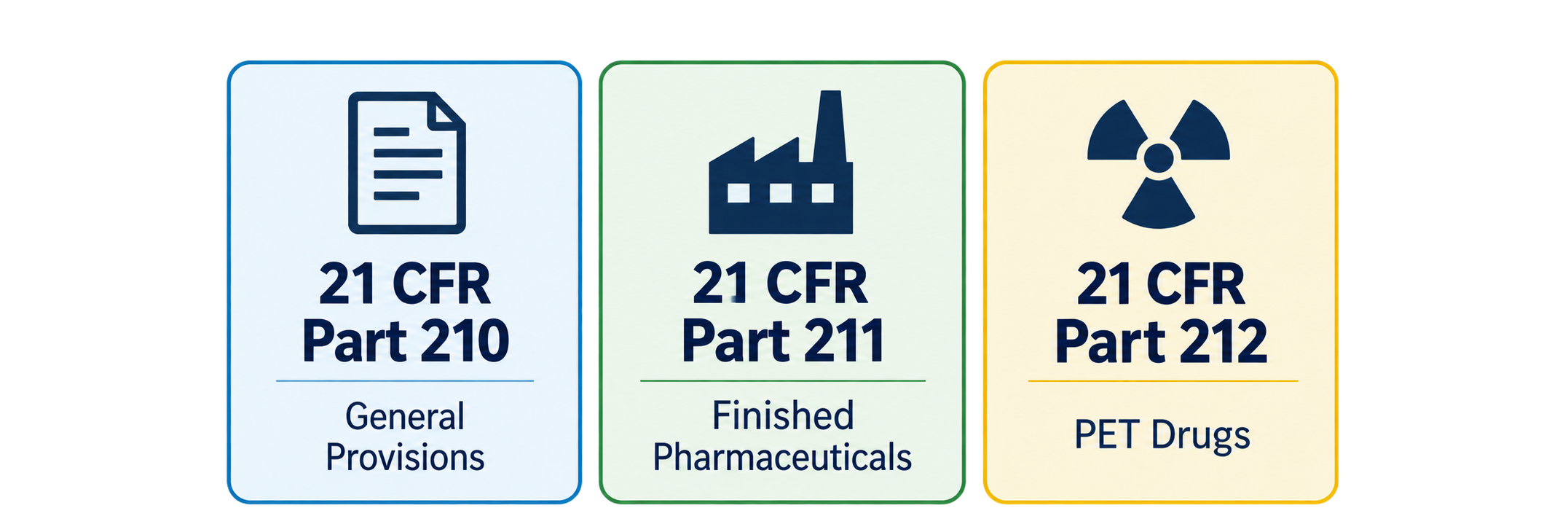
FDA drug manufacturing requires controls over materials, facilities, equipment, production, laboratories, records, and finished products. Parts 210 and 211 establish CGMP requirements, while Part 212 applies to PET drugs. FDA uses CP 7356.002 to evaluate pharmaceutical manufacturing systems. CIRG provides FDA Consulting to identify compliance gaps, strengthen quality systems, and prepare teams for inspection. Contact CIRG for practical, inspection-focused support built around documented evidence, execution, and FDA expectations before problems become observations or enforcement issues.
Understanding FDA Drug CGMP Requirements
FDA’s Current Good Manufacturing Practice requirements establish the foundation for pharmaceutical manufacturing quality in the United States. CGMP controls how manufacturers design, monitor, and manage facilities, equipment, materials, production, laboratories, and records. 21 CFR Parts 210 and 211 set core requirements for drug manufacturing and finished pharmaceuticals. These rules require manufacturers to maintain effective systems that consistently produce products meeting established quality standards. FDA also expects management to support a functioning quality system with appropriate authority and oversight. Compliance depends on execution, not procedures alone. Records, investigations, laboratory controls, production practices, and corrective actions must demonstrate ongoing control. CIRG provides FDA Consulting to help manufacturers evaluate CGMP readiness and identify weaknesses before regulatory inspection. Our approach focuses on practical evidence, process effectiveness, and inspection risk. Strong systems help manufacturers protect product quality while reducing avoidable compliance failures and regulatory exposure.
21 CFR Parts 210, 211 and 212
FDA’s drug CGMP framework spans several regulatory parts, each addressing a different aspect of pharmaceutical manufacturing. Understanding which requirements apply is essential for inspection readiness and effective FDA Consulting.
21 CFR Part 210 — General CGMP Requirements
21 CFR Part 210 establishes general CGMP requirements for manufacturing, processing, packing, and holding drugs. It defines the scope and applicability of FDA’s drug manufacturing requirements. The regulation works together with more detailed provisions in Part 211 for finished pharmaceuticals. Manufacturers must understand how these general requirements apply across their operations and quality systems. CIRG provides FDA Consulting to help companies interpret Part 210 within their broader compliance framework. We review how procedures, responsibilities, and controls support consistent execution. Strong understanding of Part 210 helps manufacturers build a regulatory foundation that supports inspection readiness and effective pharmaceutical quality management programs.
21 CFR Part 211 — Finished Pharmaceuticals
21 CFR Part 211 contains detailed CGMP requirements for finished pharmaceuticals. It covers organization and personnel, buildings, equipment, components, production, packaging, labeling, laboratory controls, records, distribution, and returned products. FDA expects manufacturers to maintain effective controls across these areas and document how those controls operate. Compliance depends on consistent execution, not written procedures alone. CIRG provides FDA Consulting to evaluate Part 211 systems against current regulatory expectations. We review quality unit oversight, manufacturing controls, laboratory practices, investigations, records, and supporting evidence. This approach helps manufacturers identify weaknesses early and strengthen the systems FDA may examine during a drug manufacturing inspection.
21 CFR Part 212 — PET Drugs
21 CFR Part 212 establishes CGMP requirements specifically for positron emission tomography drugs. PET manufacturing presents unique challenges because products often have short half-lives and require rapid production, testing, and release. FDA designed Part 212 to address these specialized operations while maintaining appropriate quality controls. Manufacturers must establish reliable procedures, laboratory practices, equipment controls, records, and release processes. CIRG provides FDA Consulting to help PET drug facilities evaluate their compliance systems and inspection readiness. We focus on practical execution, documentation, and risk. Effective Part 212 compliance helps manufacturers demonstrate control while meeting demands for producing and distributing PET drugs safely.
FDA Drug Manufacturing Inspections Under CP 7356.002
FDA uses Compliance Program CP 7356.002 to guide many human drug CGMP inspections. The program applies a systems-based, risk-focused approach and directs investigators toward the areas most relevant to product quality and compliance. CIRG FDA Consulting helps manufacturers understand this inspection model and prepare the evidence FDA may expect to see.
Six-System Inspection Model
CP 7356.002 organizes pharmaceutical manufacturing into six systems: Quality, Facilities and Equipment, Materials, Production, Packaging and Labeling, and Laboratory Control. FDA evaluates these systems as connected parts of the manufacturing operation rather than isolated functions. Personnel, records, training, and management oversight may be reviewed within the relevant system. The Quality System plays a central role because it supports and monitors the other systems. CIRG FDA Consulting helps manufacturers evaluate these connections before an inspection. We review how records, investigations, controls, and management decisions demonstrate an ongoing state of control. Strong preparation requires evidence that the systems work together in practice.
Full and Abbreviated FDA Inspections
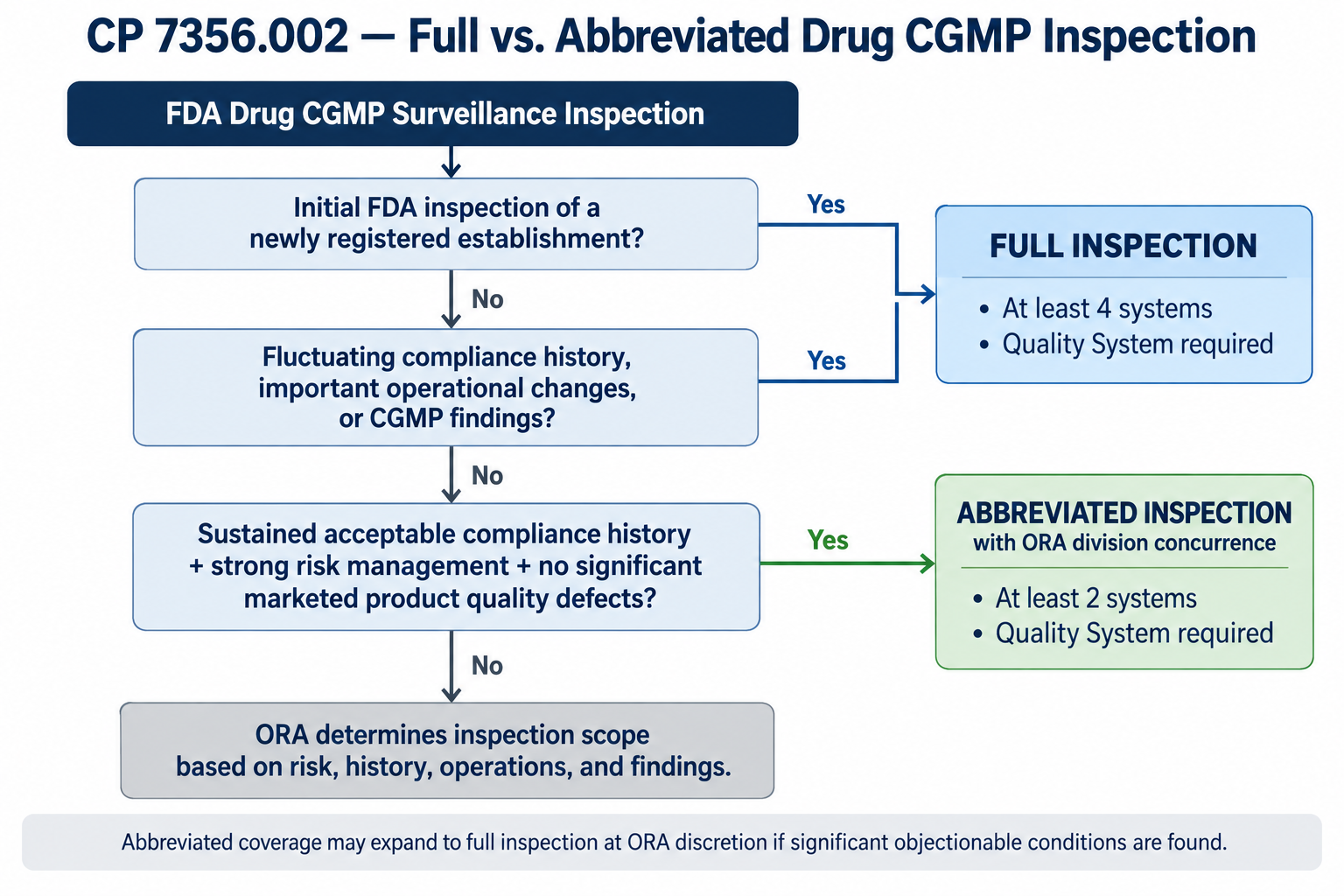
CP 7356.002 provides both full and abbreviated surveillance inspection options. A full inspection normally covers at least four systems, including the Quality System. FDA may select this approach for initial inspections, changing operations, or facilities with inconsistent compliance history. An abbreviated inspection normally covers at least two systems, with the Quality System again required. FDA may use this option when a facility has sustained acceptable compliance and limited product quality concerns. Findings can expand an abbreviated inspection into a full inspection. CIRG FDA Consulting helps companies prepare for either approach because inspection scope can change when investigators identify significant weaknesses.
Risk-Based Inspection Focus
FDA does not review every process with equal depth during every drug inspection. CP 7356.002 supports a risk-based approach that allows investigators to focus on areas with greater potential impact on product quality. Compliance history, complaints, recalls, manufacturing changes, laboratory issues, and product defects can influence inspection coverage. FDA also considers whether management responds effectively to emerging quality problems. CIRG FDA Consulting helps manufacturers identify these risk signals before an inspection begins. We examine investigations, deviations, quality trends, CAPA, laboratory data, and management oversight for weaknesses. This approach helps companies prepare for the areas most likely to attract deeper FDA scrutiny.
Data Integrity and Pharmaceutical Manufacturing Compliance
Data integrity is a core CGMP expectation because FDA relies on complete, accurate, and reliable records to evaluate product quality. Manufacturers must control both paper and electronic data throughout the record lifecycle. FDA expects firms to prevent, detect, and address data integrity risks using meaningful, risk-based controls. Weak audit trails, unexplained data changes, shared passwords, incomplete records, or missing raw data can create serious compliance concerns. CIRG provides FDA Consulting to help manufacturers assess data governance, laboratory practices, electronic systems, and record controls. We review how employees create, modify, review, retain, and report critical information. Our approach also examines management oversight and investigation practices when discrepancies occur. Strong data integrity controls support trustworthy decisions, effective quality systems, and defensible inspection responses. They also reduce the risk that FDA questions whether manufacturing or laboratory records accurately reflect actual operations.
Preparing for an FDA Drug GMP Inspection
Preparing for an FDA drug GMP inspection requires more than reviewing procedures before the investigator arrives. Manufacturers should confirm that operations, records, personnel, and quality systems consistently support CGMP requirements. Inspection readiness should include deviations, CAPA, complaints, laboratory controls, production records, equipment, materials, and management oversight. Teams also need fast, controlled document retrieval and employees who can explain their responsibilities clearly. CIRG provides FDA Consulting to test readiness before FDA identifies weaknesses. We review records, trace issues across systems, challenge investigations, and evaluate whether documented controls match actual practice. Mock inspection techniques can reveal gaps that routine internal audits may miss. Effective preparation gives management time to correct weaknesses before they become Form FDA 483 observations. The goal is simple: demonstrate control through credible evidence, consistent execution, and knowledgeable personnel throughout the inspection.
FDA Drug GMP Compliance Support
CIRG provides FDA Drug GMP Compliance Support for manufacturers that need focused, practical help with inspection readiness and quality system improvement. Our FDA Consulting can address CGMP gap assessments, mock inspections, CAPA, investigations, data integrity, laboratory controls, production systems, and management oversight. We also review documentation against applicable requirements in 21 CFR Parts 210, 211, and 212. Support can target one high-risk problem or cover a broader manufacturing system. Each engagement focuses on evidence, execution, and the compliance risks most likely to attract FDA attention. CIRG helps teams identify weak controls before those issues become inspection findings or enforcement concerns. We also help management prioritize remediation based on risk and regulatory impact. The objective is not paperwork for its own sake. It is a quality system that performs consistently and withstands FDA scrutiny.
Drug Compliance Through an FDA Inspection Perspective
Drug compliance looks different when viewed through the eyes of an FDA investigator. Investigators do not evaluate written procedures in isolation. They compare procedures with records, employee practices, investigations, laboratory data, and actual manufacturing conditions. One weakness can lead FDA into related systems when the evidence suggests broader control problems. CIRG FDA Consulting applies an inspection-focused perspective to help manufacturers prepare for that reality. We examine how quality events connect across systems and where an investigator may pursue follow-up questions. Particular attention goes to repeated deviations, weak investigations, ineffective CAPA, data integrity concerns, and poor management oversight. Our approach helps companies recognize issues that may appear minor internally but carry greater regulatory significance during inspection. Preparing from an FDA inspection perspective strengthens both compliance and response strategy. It also helps management address root causes before observations escalate into costly remediation or enforcement.
Engage CIRG for Drug GMP Inspection Readiness
CIRG provides FDA Consulting for pharmaceutical manufacturers preparing for FDA drug GMP inspections under 21 CFR Parts 210, 211, and 212. Our support can include targeted compliance reviews, gap assessments, remediation planning, and a structured mock FDA GMP inspection.
A mock GMP inspection tests how your quality system performs under realistic FDA-style questioning. CIRG reviews records, follows system connections, evaluates employee responses, and identifies weaknesses that may create inspection risk. Areas can include Quality, Facilities and Equipment, Materials, Production, Packaging and Labeling, and Laboratory Control.
Following the assessment, CIRG provides practical findings and prioritized recommendations. The goal is to identify problems before FDA does and help your team enter the inspection with stronger systems, better documentation, and greater confidence.
Contact CIRG to discuss FDA drug GMP inspection readiness or schedule a mock GMP inspection.