
FDA Regulatory Submissions: PMA and NDA
FDA regulatory submissions require disciplined integration of clinical, nonclinical, manufacturing, quality, statistical, and labeling evidence. PMA applications support FDA review of Class III medical devices under 21 CFR Part 814, while NDAs support approval of new drugs under 21 CFR Part 314. CIRG provides FDA Consulting to help sponsors assess submission readiness, identify evidence gaps, organize regulatory documentation, and prepare for FDA review. Our approach focuses on scientific credibility, traceability, completeness, and a defensible regulatory strategy.
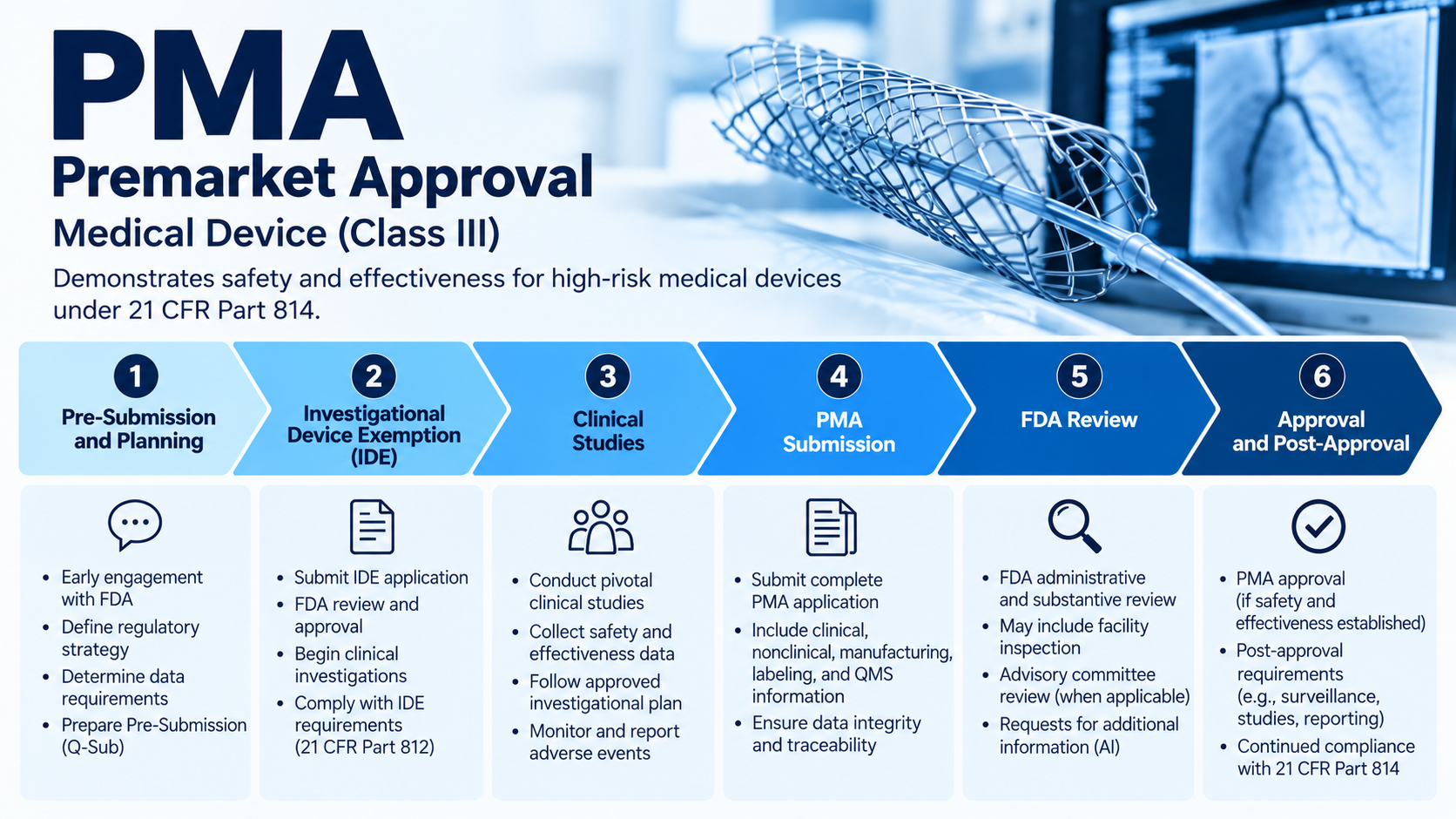
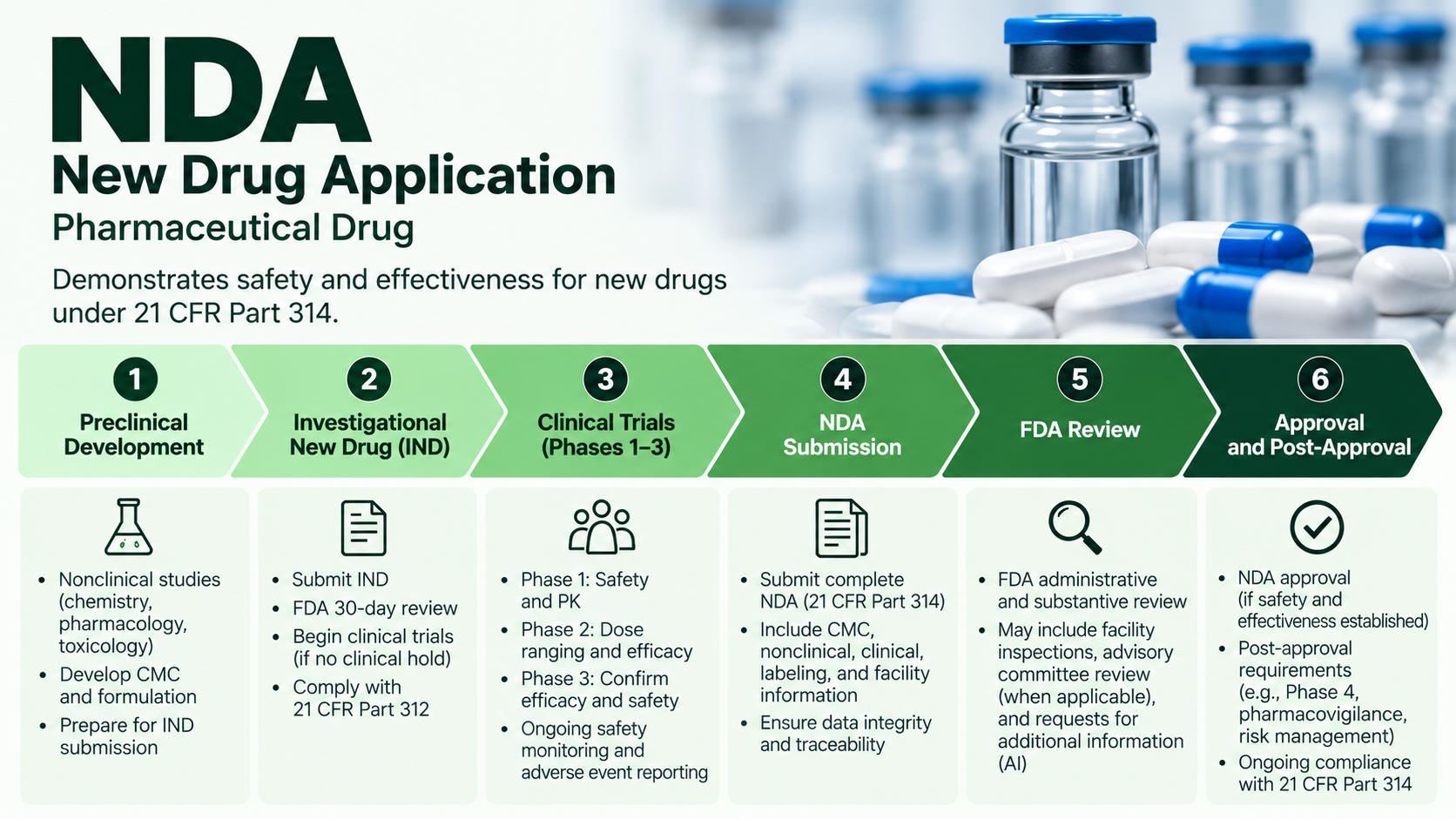
What Is a Premarket Approval (PMA)?
A Premarket Approval, or PMA, is FDA’s most stringent marketing application for medical devices. It generally applies to Class III devices with the highest regulatory risk. The applicant must provide scientific evidence showing reasonable assurance that the device is safe and effective for its intended use. A PMA can include clinical studies, nonclinical testing, manufacturing information, labeling, and quality system documentation. FDA reviews this information before allowing the device to enter the U.S. market. CIRG provides FDA Consulting to help manufacturers identify submission gaps, organize evidence, and prepare for regulatory review. The governing regulation for PMAs is 21 CFR Part 814.
What Is a New Drug Application (NDA)?
A New Drug Application, or NDA, asks FDA for permission to market a new pharmaceutical drug in the United States. The application brings together information developed during preclinical studies, the IND program, and human clinical trials. FDA evaluates whether the drug is safe and effective for its proposed use. Reviewers also examine labeling and determine whether manufacturing methods can consistently produce a drug of acceptable identity, strength, quality, and purity. NDA requirements appear primarily in 21 CFR Part 314. CIRG FDA Consulting helps sponsors evaluate submission readiness, organize regulatory evidence, identify gaps, and prepare manufacturing operations for FDA review before the application reaches critical decision points.
PMA and NDA: What Is the Difference?
PMA and NDA applications serve a similar purpose: both seek FDA permission to market a regulated product. However, they apply to different product types. A PMA generally supports approval of a high-risk Class III medical device. An NDA supports approval of a new pharmaceutical drug. Device applications focus heavily on device design, performance, clinical evidence, manufacturing, and the quality management system. Drug applications include clinical and nonclinical evidence plus extensive chemistry, manufacturing, and controls information. Both pathways can involve clinical data review, manufacturing assessments, facility inspections, labeling review, and FDA questions. CIRG supports both pathways, allowing sponsors to address device and drug requirements within one FDA Consulting framework.
Clinical Evidence Supporting PMA and NDA Approval
Clinical evidence often becomes one of the most important parts of a PMA or NDA. Medical device sponsors may conduct studies under an Investigational Device Exemption before submitting a PMA. Drug sponsors generally conduct clinical trials under an Investigational New Drug application before preparing an NDA. FDA evaluates whether the resulting evidence supports the proposed indication and demonstrates acceptable safety and effectiveness. Regulators may also inspect clinical investigators, sponsors, CROs, or other research organizations through the BIMO program. CIRG FDA Consulting helps sponsors connect clinical evidence with regulatory submission requirements. Strong submissions require more than positive study results. FDA must also trust how the study was conducted, documented, monitored, and reported.
Manufacturing Readiness and FDA Pre-Approval Inspections
FDA approval does not depend only on successful clinical results. Manufacturing operations must also demonstrate that the commercial product can be produced consistently and according to applicable FDA requirements. For drug applications, FDA uses Compliance Program 7346.832 for risk-based Pre-Approval Inspections of facilities supporting pending applications. These inspections can verify manufacturing readiness, application accuracy, laboratory methods, and data integrity. Significant problems can delay approval. Medical device PMA review can also include manufacturing and quality system evaluation, including facility inspection when appropriate. CIRG provides FDA Consulting and mock pre-approval inspection support to identify weaknesses before FDA arrives. Preparing early helps connect the submitted application with actual manufacturing operations.
Manufacturing Readiness and FDA Pre-Approval Inspections
FDA approval does not depend only on successful clinical results. Manufacturing operations must also demonstrate that the commercial product can be produced consistently and according to applicable FDA requirements. For drug applications, FDA uses Compliance Program 7346.832 for risk-based Pre-Approval Inspections of facilities supporting pending applications. These inspections can verify manufacturing readiness, application accuracy, laboratory methods, and data integrity. Significant problems can delay approval. Medical device PMA review can also include manufacturing and quality system evaluation, including facility inspection when appropriate. CIRG provides FDA Consulting and mock pre-approval inspection support to identify weaknesses before FDA arrives. Preparing early helps connect the submitted application with actual manufacturing operations.
Responding to FDA Questions During Application Review
Submitting a PMA or NDA does not usually end communication with FDA. Reviewers may request clarification, additional data, revised analyses, manufacturing information, or changes to proposed labeling. Medical device PMA review includes administrative and substantive review, and FDA can request additional information before reaching a decision. Drug reviewers similarly evaluate clinical, manufacturing, labeling, and other technical information throughout NDA review. Sponsors need controlled responses that answer FDA’s questions directly and remain consistent with the rest of the application. CIRG FDA Consulting helps teams evaluate regulatory questions, coordinate subject-matter responses, and identify supporting evidence. Clear, complete, and technically defensible responses can prevent unnecessary confusion and keep the review moving forward.
How CIRG Supports PMA and NDA Submissions
CIRG supports medical device PMA and pharmaceutical NDA programs from an FDA regulatory and inspection perspective. Our FDA Consulting can include submission readiness assessments, regulatory strategy, clinical evidence review, quality and manufacturing assessments, BIMO readiness, document review, and preparation for FDA questions. We also provide mock FDA inspections when manufacturing or clinical operations may face regulatory scrutiny. The objective is not simply to assemble documents. A successful application must tell one consistent regulatory story across clinical evidence, manufacturing controls, labeling, quality systems, and supporting records. CIRG helps sponsors identify weak points before FDA review exposes them and prioritize corrections that can affect approval, inspection readiness, or regulatory credibility.