
Sterilization Validation
CIRG FDA Consulting brings former FDA experience to sterilization validation for medical device manufacturers facing complex regulatory and technical requirements. We help companies select appropriate standards, develop validation strategies, review protocols, and evaluate whether supporting data justify each conclusion. In addition, our team reviews process controls, requalification, deviations, CAPA, change control, and risk management for consistency across the quality system.
Our FDA consulting approach focuses on how an investigator may evaluate the entire sterilization program, not just individual reports. Therefore, we look for gaps between procedures, validation records, production controls, and actual practices. We also support mock FDA inspection activities when manufacturers want to test inspection readiness before regulators arrive.
CIRG helps manufacturers apply ISO 11135, ISO 11137, ISO 17665, ISO 20857, ISO 22441, and ISO 14937. Most importantly, we focus on evidence, traceability, and defensible regulatory decisions during FDA inspections.
Understand the Worst-Case Product and Its Most Challenging Area
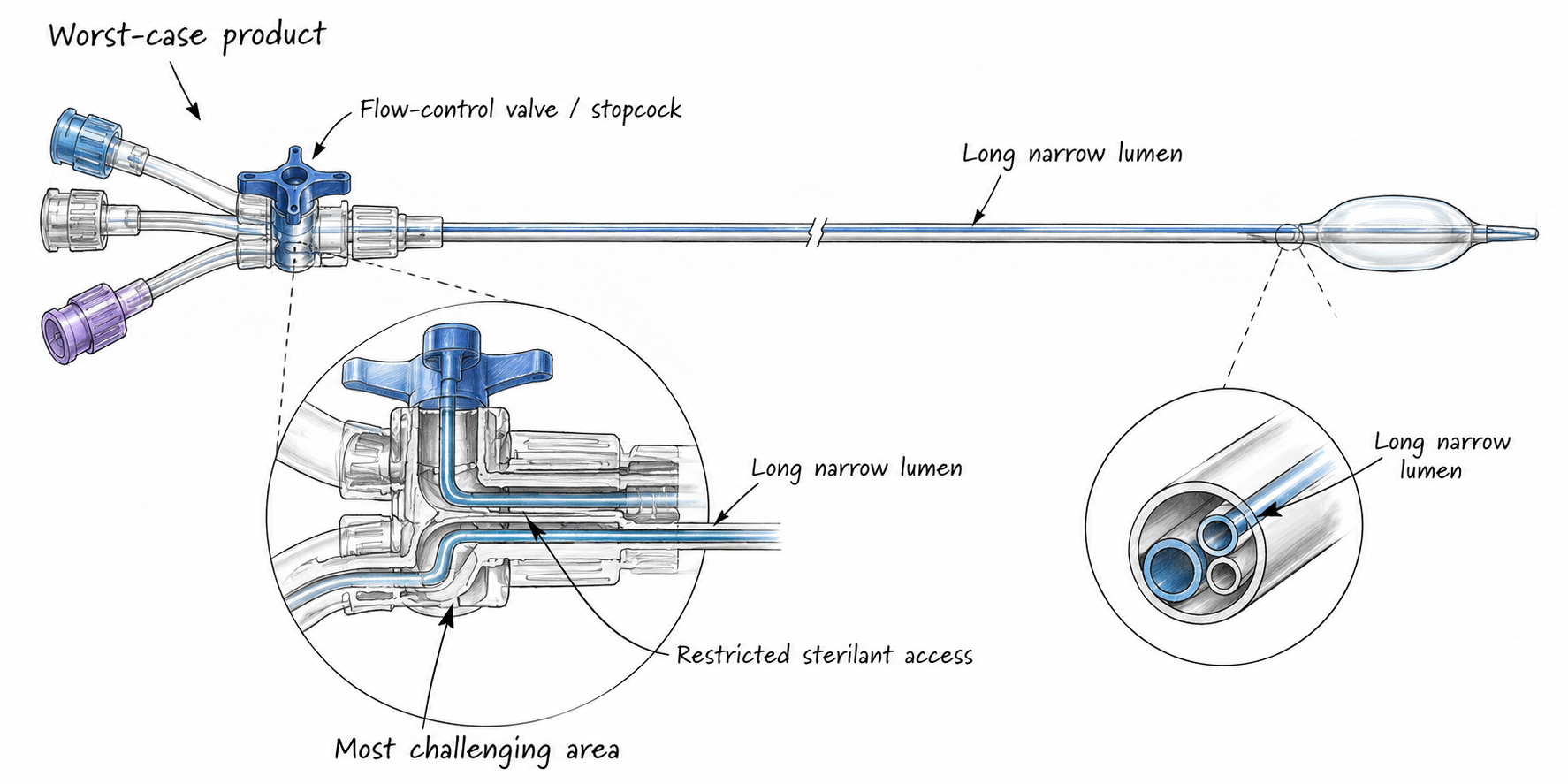
Sterilization Validation begins with identifying the worst-case product within the proposed product family. Selection should be based on characteristics that create the greatest challenge to the sterilization process, such as size, mass, material composition, device complexity, packaging configuration, lumen dimensions, or restricted sterilant access.
However, selecting the worst-case product alone is not sufficient. The manufacturer must also identify the most challenging location within that product—the area where sterilant penetration, energy delivery, heat transfer, or microbial inactivation may be most difficult to achieve. Examples may include narrow lumens, internal channels, mated surfaces, enclosed spaces, dense assemblies, or other locations shielded from the sterilization process.
The rationale for both selections should be scientifically justified and documented. Our FDA consulting approach evaluates whether these worst-case determinations are supported by product design, process knowledge, risk analysis, and appropriate technical evidence.
Start with AAMI TIR17 to Evaluate Sterilization Options
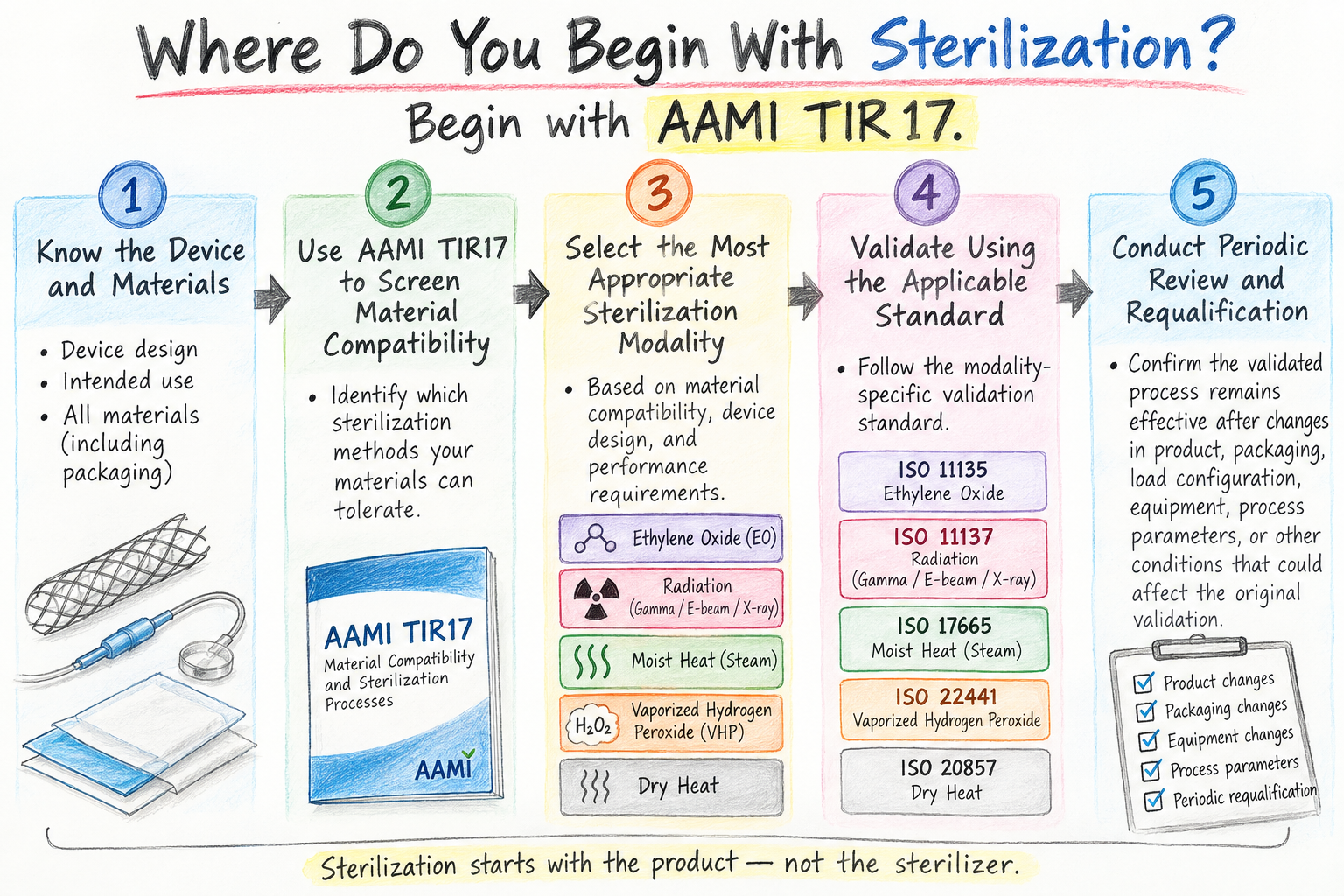
Once the worst-case product and its most challenging area are understood, the next step is selecting a sterilization method that is compatible with the device, its materials, packaging, and intended use.
AAMI TIR17 provides a useful starting point for evaluating how materials may respond to different sterilization technologies. The assessment should consider potential effects on polymers, adhesives, electronics, coatings, mechanical properties, functionality, packaging, and product life.
However, material compatibility is only part of the decision. Sterilant penetration, device geometry, temperature sensitivity, residuals, processing time, scalability, and regulatory acceptance must also be considered.
A sound Sterilization Validation strategy therefore uses AAMI TIR17 as an early screening tool, then applies the appropriate process-specific standard. Our FDA consulting approach evaluates whether the selected sterilization method is technically justified for the actual product rather than chosen simply because it is familiar or readily available.
Selecting the Appropriate Sterilization Method
Selecting the appropriate sterilization method requires more than choosing a familiar technology. The decision should be based on the device design, material compatibility, packaging system, product configuration, bioburden, manufacturing process, and the most difficult area to sterilize.
Ethylene oxide may be appropriate for complex devices with long or narrow lumens because of its penetration capability. Radiation may be efficient for compatible disposable products, while moist heat is generally suited to materials that can tolerate elevated temperature and moisture. Other technologies, including dry heat and vaporized hydrogen peroxide, may be appropriate when product characteristics support their use.
A sound Sterilization Validation program should document why the selected method is suitable and why significant alternatives were not chosen. Our FDA consulting approach evaluates whether the selection is supported by technical evidence, product risk, material limitations, processing requirements, and the applicable sterilization standard.
ISO 11135 — Ethylene Oxide Sterilization
ISO 11135 establishes requirements for developing, validating, and routinely controlling ethylene oxide sterilization processes for medical devices. EO is particularly useful for temperature- or moisture-sensitive products and complex devices where the sterilant must penetrate packaging, internal pathways, mated surfaces, or narrow lumens.
Successful Sterilization Validation requires more than demonstrating microbial lethality. Manufacturers must define the product and load, characterize the process, establish appropriate cycle parameters, and demonstrate consistent performance under defined worst-case conditions. Critical variables can include temperature, humidity, EO concentration, exposure time, conditioning, and aeration.
Product configuration and the location most difficult for EO to reach should be addressed during validation. In addition, changes to product design, packaging, loading patterns, or processing conditions should be evaluated for their potential impact. Our FDA consulting approach reviews whether the EO validation remains scientifically justified throughout the product lifecycle.
ISO 11137 — Radiation Sterilization
The ISO 11137 series addresses sterilization using ionizing radiation, including gamma radiation, electron beam, and X-ray technologies. Radiation can provide an efficient terminal sterilization method for many single-use medical devices because processing can occur after the product has been packaged.
However, radiation compatibility must be established for the actual device and packaging system. Polymers, adhesives, electronics, coatings, and other materials can respond differently to radiation exposure. Therefore, both the minimum dose needed to achieve the required microbiological effectiveness and the maximum dose the product can tolerate must be considered.
Sterilization Validation also requires appropriate dose establishment, dose mapping, routine process control, and continued verification that the validated dose remains suitable. Product density, orientation, packaging, and loading configuration may affect dose distribution. Our FDA consulting review examines whether radiation sterilization decisions are supported by microbiological data, product compatibility, dosimetry, and a justified worst-case configuration.
ISO 17665 — Moist Heat Sterilization
ISO 17665 establishes requirements for the development, validation, and routine control of moist heat sterilization processes for medical devices. Moist heat is highly effective when the product and packaging can tolerate elevated temperature, moisture, and the selected exposure conditions.
A Sterilization Validation program should demonstrate that the required sterilization conditions reach the location within the product or load that is most difficult to heat and sterilize. Temperature distribution, heat penetration, air removal, steam quality where applicable, exposure time, loading configuration, and process reproducibility can directly affect performance.
Validation should also address the actual product configuration and representative worst-case loads rather than relying only on empty-chamber qualification. Furthermore, changes to packaging, load patterns, equipment, or product design may require documented evaluation. Our FDA consulting approach evaluates whether moist heat validation demonstrates consistent delivery of the validated process to the most challenging product and load locations.
ISO 20857 — Dry Heat Sterilization
ISO 20857 specifies requirements for developing, validating, and routinely controlling dry heat sterilization processes for medical devices. The standard also addresses dry heat depyrogenation applications. Dry heat is generally most appropriate for products and materials capable of tolerating the temperatures required for the process.
Unlike moist heat, dry heat relies on heat transfer without the benefit of steam. Therefore, Sterilization Validation should carefully evaluate temperature distribution, heat penetration, exposure time, product configuration, equipment performance, and the location that represents the greatest thermal challenge.
The validation should demonstrate that the required conditions are consistently achieved throughout the defined load, including the slowest-to-heat location. Where depyrogenation is claimed, the applicable performance requirements should also be scientifically established and verified. Our FDA consulting approach reviews whether dry heat cycle development, qualification, load definition, monitoring, and routine control provide adequate evidence that the process remains reproducible and effective.
ISO 22441 — Vaporized Hydrogen Peroxide Sterilization
ISO 22441 addresses low-temperature sterilization of medical devices using vaporized hydrogen peroxide as the sterilizing agent. The process can be useful for compatible heat-sensitive devices and is used in both health care and industrial applications.
However, device geometry can significantly affect process performance. Long or narrow lumens, enclosed spaces, mated surfaces, packaging configurations, and restricted pathways may create challenges for vaporized hydrogen peroxide distribution and contact. Therefore, Sterilization Validation should identify the most difficult location for the sterilant to reach and demonstrate effective processing under defined worst-case conditions.
Material compatibility must also be evaluated because product composition can affect both sterilant interaction and device performance. Process development should define critical operating parameters, product configuration, loading conditions, and routine controls. Our FDA consulting approach reviews whether the validation adequately connects product design, process capability, microbiological effectiveness, and documented worst-case justification.
ISO 14937 — General Requirements for Sterilization Processes
ISO 14937 provides general requirements for characterizing a sterilizing agent and for developing, validating, monitoring, and routinely controlling a sterilization process for medical devices. It is particularly important when a sterilization technology does not have a dedicated process-specific international standard.
The standard provides a framework for understanding the sterilizing agent, its microbiological effectiveness, process characteristics, equipment, product definition, validation, and routine control. However, ISO 14937 should not automatically replace a specific sterilization standard when an established standard already applies to the selected technology.
For Sterilization Validation involving a new or less established modality, the manufacturer should build a scientifically supported relationship between the sterilizing agent, process parameters, product characteristics, and demonstrated microbial inactivation. Our FDA consulting approach evaluates whether the process has been adequately characterized, whether critical variables are controlled, and whether the validation provides sufficient evidence to support consistent routine sterilization.
Develop and Validate the Sterilization Process
Once the sterilization method is selected, the process must be developed around the actual product, packaging, equipment, and manufacturing conditions. Process development should identify the parameters that influence microbial inactivation and determine acceptable operating ranges before formal qualification begins.
Sterilization Validation typically includes installation qualification, operational qualification, and performance qualification, supported by documented scientific rationale. The validation should challenge the process under defined worst-case conditions rather than simply demonstrate that a normal production cycle works.
Critical parameters may include temperature, pressure, humidity, sterilant concentration, radiation dose, exposure time, load configuration, or other technology-specific variables. Acceptance criteria should be established before execution and supported by appropriate data.
Our FDA consulting approach evaluates whether process development, qualification activities, and acceptance criteria demonstrate that the sterilization process is controlled, reproducible, and capable of consistently achieving its intended result.
Establish the Sterility Assurance Level and Microbiological Basis
Sterilization Validation must be supported by a sound microbiological strategy. Manufacturers should understand the product bioburden, its variability, the resistance of relevant microorganisms, and how those factors relate to the selected sterilization process.
For terminally sterilized medical devices, a sterility assurance level of 10⁻⁶ is commonly applied where appropriate. However, achieving the required SAL should be demonstrated through the methodology specified by the applicable sterilization standard rather than assumed from cycle settings alone.
Bioburden testing, biological indicators, dose establishment, microbial resistance studies, or other microbiological methods may be required depending on the sterilization technology. Sampling plans and test methods should also be scientifically justified.
Our FDA consulting review examines whether the microbiological basis of the Sterilization Validation is supported by representative data, appropriate test methods, documented rationale, and clear linkage between microbial challenge and validated process capability.
Validate the Worst-Case Product and Load Configuration
A sterilization process is only as strong as the worst-case conditions demonstrated during validation. Manufacturers should identify the product, packaging configuration, load arrangement, and internal location that create the greatest challenge to delivery of the sterilizing conditions.
Worst-case selection should be based on technical characteristics rather than convenience. Factors may include product density, lumen length and diameter, restricted pathways, packaging barriers, device mass, materials, load position, or locations that are difficult for heat, radiation, or sterilant to reach.
Performance qualification should demonstrate that the validated process remains effective at these challenging locations and configurations. Product families may be grouped when scientifically justified, but the rationale should clearly establish why the selected representative product covers the remaining products.
Our FDA consulting approach evaluates whether Sterilization Validation worst-case assumptions are supported by product knowledge, process data, risk assessment, and documented evidence.
Establish Routine Monitoring and Process Control
Validation does not end when the qualification report is approved. The manufacturer must establish routine controls that demonstrate each production cycle remains within the validated process parameters.
Routine monitoring should focus on the critical parameters established during Sterilization Validation. Depending on the technology, this may include temperature, pressure, humidity, sterilant concentration, exposure time, radiation dose, biological indicators, chemical indicators, or other validated process measurements.
Acceptance criteria should be clearly defined, and procedures should address what happens when a cycle falls outside established limits. Deviations should be investigated to determine whether product sterility, process capability, or the validated state may have been affected.
Our FDA consulting approach reviews whether routine monitoring records provide objective evidence that the sterilization process remains under control and whether deviations, investigations, and product disposition decisions are scientifically supported and properly documented.
Requalification and Change Control
Sterilization processes must remain in a validated state throughout the product lifecycle. Periodic requalification provides evidence that the process continues to perform as originally validated, while change control determines whether modifications could affect sterilization effectiveness.
Changes to device design, materials, packaging, suppliers, equipment, sterilization facilities, load configuration, manufacturing processes, or cycle parameters should be evaluated for potential impact. Even seemingly minor changes may affect sterilant penetration, heat transfer, radiation dose distribution, or product compatibility.
The manufacturer should define when requalification is required, what level of testing is appropriate, and how the decision is documented. Trends, deviations, maintenance activities, and process performance data should also be considered.
Our FDA consulting approach evaluates whether Sterilization Validation remains current and whether change-control and requalification decisions are supported by risk assessment, technical evidence, and the applicable sterilization standard.
Sterilization Validation Documentation and FDA Inspection Readiness
FDA investigators may evaluate far more than the final validation report. They can review how the sterilization method was selected, how worst-case products were identified, whether protocols were approved before execution, how deviations were handled, and whether routine processing remains within the validated state.
A complete Sterilization Validation package should provide a clear trail from product definition and process development through qualification, microbiological evidence, acceptance criteria, routine monitoring, requalification, and change control. Supporting records should be consistent with procedures and actual manufacturing practices.
Documentation gaps can become significant when the scientific rationale exists only in institutional knowledge rather than controlled records. Therefore, technical decisions should be traceable and defensible.
Our FDA consulting approach reviews the entire sterilization system from an investigator’s perspective, helping manufacturers identify gaps before they become inspection observations or require difficult explanations during an FDA inspection.
Sterilization Validation Tips and Common Traps
Sterilization Validation can fail before validation even begins if the wrong sterilization method is selected. Do not choose EO, radiation, steam, or another modality simply because it is familiar, available, or already used by the contract sterilizer. This is particularly important with ethylene oxide. If EO is selected, understand exactly why the product requires it. Complex geometries, long lumens, restricted pathways, temperature-sensitive materials, packaging, or material incompatibility with alternative methods may provide a technically sound rationale. However, the decision should be documented and supported by product-specific evidence.
Another common trap is selecting the easiest product or load for validation rather than the true worst case. Product families, load configurations, process challenge locations, and material limitations all require justification.
Always Validate for Your Specific Product
A sterilization process should be developed and justified for your specific product, packaging configuration, materials, bioburden, and worst-case characteristics. Do not assume that an existing cycle from a contract sterilizer, original supplier, or similar device is automatically suitable. A contractor may provide a proven process, but the manufacturer still needs to demonstrate that the process is appropriate for its own product. Differences in geometry, lumen dimensions, density, packaging, materials, load configuration, or microbial challenge can significantly affect sterilization performance.
Sterilization Validation should therefore establish a clear connection between the selected process and the actual device being released to market. Existing cycles may provide useful starting information, but they do not replace product-specific technical justification. Our FDA consulting approach examines whether the manufacturer can clearly explain why the selected process is suitable for its product—not simply why the contractor has used it before.
Parameter Setting Is Critical
Sterilization parameters should never be copied from another product or accepted simply because they fall within a contractor’s standard cycle. Each critical process parameter should be established through process development and supported by evidence showing that the selected range is appropriate for the product and sterilization modality.
Depending on the method, critical parameters may include temperature, pressure, humidity, sterilant concentration, exposure time, radiation dose, conditioning, aeration, vacuum levels, or load configuration. The interaction among these variables can be just as important as any single parameter. Sterilization Validation should establish both acceptable operating ranges and the conditions that represent the greatest process challenge. Parameters should be capable of delivering effective sterilization without adversely affecting product performance or materials.
Don’t Take Someone’s Word for It
Sterilization decisions should never rely solely on “this is how we have always done it,” a contractor’s standard cycle, or an unsupported assurance that the process is acceptable. If the rationale is unclear, the evidence is incomplete, or the applicable standard is difficult to interpret, resolve the issue before validation, submission, or inspection.
Sterilization Validation is becoming more complex as products, materials, technologies, and regulatory expectations evolve. Regulators also have greater access to technical expertise, inspection history, scientific data, and industry information than ever before.
If you are unsure, do not guess and do not wait until FDA asks the question. Get expert help early. CIRG FDA Consulting can review the sterilization strategy, challenge the assumptions, identify gaps, and help determine what evidence is needed before a manageable issue becomes a failed validation, submission delay, inspection observation, or major remediation project.